

CHDCM Undergraduate Students Present Research at Big East Symposium at Madison Square Garden
Thursday, April 16, 2026
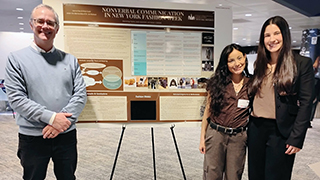
Jon Radwan, Ph.D., Lianna Cruz and Maia Coyle at the Big East Undergraduate Research Poster Symposium
Three undergraduate students from the College of Human Development, Culture and Media (CHDCM) presented their research at the Big East Undergraduate Research Poster Symposium held March 14, 2026, at Madison Square Garden.
The symposium features undergraduate research, showcasing work from the natural sciences, physical sciences, social sciences, humanities, nursing, business, engineering and the fine arts. Representing CHDCM were, Maia Coyle, Lianna Cruz and Gianna Vaynberg.
Coyle and Cruz, under the mentorship of Associate Professor Jon Radwan, Ph.D. co-presented research examining how garments and dance performed nonverbal communication in New York Fashion Week 2025. Their project, “Nonverbal Communication in New York Fashion Week,” explores how “rhythm, body movement and dance build meaning” within fashion shows.
The project originated as a class assignment in Professor Radwan’s "COMM 2630 Nonverbal Communication" course, which asked students to analyze nonverbal variables in a context of their choice. After noticing that in-class discussions of nonverbal communication in the arts highlighted dance, the pair became interested in exploring how choreutic principles operate in fashion shows. Cruz explained that the team conducted “a close visual analysis of three shows from New York Fashion Week 2025 using terms, concepts and frameworks from prolific communication theorists.”
Following their initial presentation at the Petersheim Academic Exposition, the project continued to grow. The pair received the Petersheim Student Travel Award and later presented their work at the New York State Communication Association’s Fall 2025 Conference. Next, their project was competitively selected as Seton Hall's top contender for the Big East Undergraduate Research Symposium.
Coyle said her interest stems from her background as a Communication major and her fascination with the intersection of nonverbal communication and fashion, noting that it applies “long-studied elements to the most common art form of clothing” in a culturally significant space.
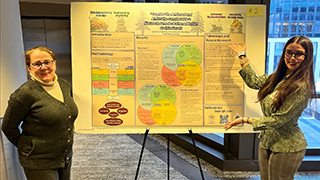
Mary Balkun, Ph.D. and Gianna Vaynberg
Vaynberg, working under the mentorship of Professor Mary Balkun, Ph.D., presented her research entitled, “‘Comfort the Afflicted and Afflict the Comfortable’: Nature in Female-Authored British Gothic Novels,” examining how awe and terror are represented in nature within Gothic literature and how these representations relate to social ostracization. Her project examines several major female-authored Gothic works, such as Jane Eyre, Frankenstein, Wide Sargasso Sea and Rebecca. As Vaynberg explains, “The common motif of the natural world in British Gothic literature is as a ‘sublime space’ that evokes awe and terror.”
Her interest in the topic developed through her prior coursework and research. Vaynberg began exploring perspective-based nuances in literature in Professor Balkun’s Women and Literature class, where she became interested in what defines a person or space as 'monstrous.' She later expanded this work through published research and, in an independent study, broadened her focus to British Gothic literature using an ecocritical lens to examine how characters interact with nature.
Each student also reflected on how they hope their research contributes to broader academic conversations. Coyle said she hopes the project creates “more opportunities and discoveries for the variables and theories of dance drawn from communication theorists to be applied to underexamined topics, such as fashion.” Cruz added that she hopes the work contributes to “a more unified communication concept in which the connection between performance and materiality is more clearly linked” and serves as a foundation for future research on fashion and communication.
For Vaynberg, the project highlights how literature can reshape how readers think about social power and the natural world. She noted that nature in Gothic literature often serves as a space that can “…comfort the afflicted and afflict the comfortable,” challenging social hierarchies and offering new ways to interpret both literature and society.
Categories: Research