
Students Gain NGO Experience Through Idea Hall Project
Tuesday, May 26, 2026
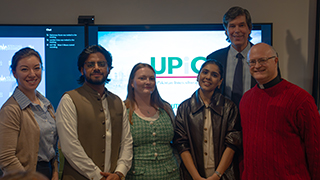
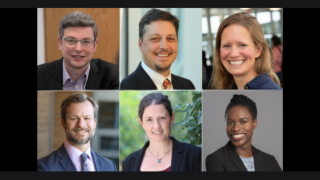
UPIC Student Representatives with Father Brian Muzas, Reverend Robert Chase and Suha Lalani, co-founder PinkDetect.
Reverend Brian Muzás, Ph.D., director of The School of Diplomacy’s Center for UN and Global Governance Studies, believes that studying diplomacy and international relations should not be confined to the classroom. Professor Muzás demonstrated this over the spring semester, when he connected students in his "Religion, Race, and International Relations" course, to a group of NGOs and created experiential learning opportunities for the class. With funding from the University’s Idea Hall initiative, the project evolved into the Global Women’s Health Innovation Through Cross-Cultural Service-Learning Initiative, organized through the U.S.-Pakistan Intercultural Coalition. UPIC supports on-ground peacebuilding among civil society groups in the U.S. and Pakistan. UPIC is newly affiliated with the School of Diplomacy’s Center for UN and Global Governance Studies at Seton Hall.
UPIC partnered with three groups to implement the project. The first, PinkDetect, is an award-winning social enterprise, advancing early breast cancer detection using Pakistan’s first AI powered breast health management app. They also joined forces with Just Results LLC and Rose Castle Foundation, to create content for Professor Muzás’ course, simply referred to as RRIR by his students. The initiative was also supported by three diplomacy graduate students: Joella Zwack, Caitlin Wilson, and Safwan Ali, who completed professional development fellowships with UPIC.
Before a series of three public workshops began, an in-class skill-building session took place. The first part of this class was led by Kate Sierra, senior instructional designer at Seton Hall, who gave students a guided introduction to a suite of Adobe tools. PinkDetect co-founders, Solmaz Ebrahimi-Iranpour and Suha Suleman Lalani, then led the students through a social media content creation exercise in which they took on the role of an international relations marketing agency, designing new health advocacy campaigns. The students gained skills needed to develop their first digital artifact project for the course, designing new health advocacy campaigns for PinkDetect.
Next, a public skill-building session focused on scriptural reasoning, a method of interfaith dialogue in which participants from different religious traditions read and reflect on their sacred texts. The workshop was led by guest speaker Matthew E. Vaughan, Ph.D., associate director of Instructional Design and Operations at Columbia University, and Rabbi Reuven Firestone, Regenstein Professor in Medieval Judaism and Islam at Hebrew Union College, joining in for the practical demonstration.
A second public workshop was organized by Just Results LLC, a DC-based international development enterprise that applies data- and technology-supported solutions to economic growth. The workshop examined how racial and ethnic dynamics work across diverse political and cultural contexts before guiding students through a theory-of-change exercise using real-world case studies from Brazil, Haiti, the Democratic Republic of Congo and the Dominican Republic.
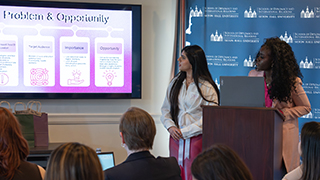
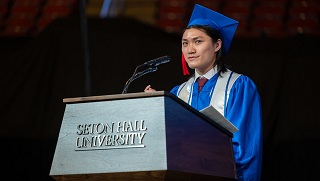
Students Presenting Digital Solutions at the Idea Hall Hackathon.
The final public workshop, a “Student Innovation Hackathon,” featured student teams that created digital solutions for PinkDetect to support their expansion in East Africa and allowed students to practice skills learned in prior workshops. The students’ digital creations were judged by a panel of guest speakers. Prizes were awarded at the closing reception. The gathering also celebrated the official launch of UPIC as a peacebuilding program within the United Nations Center at the School of Diplomacy and International Relations.
UPIC Executive Director Anjum Malik co-taught the RRIR course and noted the students’ progress. “The project was a celebration of Seton Hall's student talent and achievements,” Malik explains. “The most fulfilling part was seeing sustained student engagement and growth, whether through workshop discussion groups, one-on-one meetings, or email exchanges.”
“I never thought I would read passages from the Quran,” graduate student Zachary Cooney reflected. “This enabled me to discover the similarities and beauties between interreligious texts. The workshops and class taught me to be a more open-minded individual when discussing religion and race.”
Students appreciated the professional development aspect of the program. Safwan Ali noted that, “Organizing Idea Hall workshops strengthened my project management skills and allowed me to connect with a diverse group of people from external partners.”
In bringing together students, practitioners, sacred texts, and start up pitches under one initiative, the course, supported by Idea Hall, modeled diplomacy education based in the complexities of the world, and proved the capacity of students to engage in it.
Categories: Education, Nation and World