
Holocaust Speaker Fran 'Fray' Malkin Highlights the Power of Testimony in Shaping Ethical Classrooms
Monday, June 8, 2026
When you listen to a Witness, you become a Witness.
- Elie Wiesel, author, professor, activist, Nobel laureate and Holocaust Survivor.
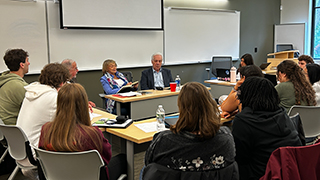
Fran Malkin Speaking to Students.
On April 28, 2026, James K. Daly, Ed.D., and Secondary Education students in Instructional Theory and Practice welcomed Holocaust Speaker Fran Malkin to campus.
This commemoration event was co-sponsored by the Center for Global Education at Seton Hall and the Center for the Study of Genocide and Human Rights at Rutgers University. Malkin was joined by Igor Kotler, a member of the NJ Commission on Holocaust Education and founder of the Museum of Human Rights, Freedom and Tolerance in Millburn, NJ. Board members of the Sister Rose Thering Fund for Education in Jewish-Christian Studies, Heather Mecka and Deborah Lerner Duane, were in attendance.
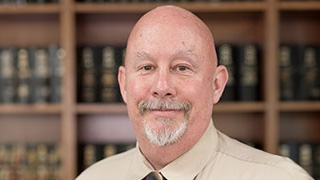
The event opened with remarks from Daly, who invited students to re-reflect on a letter written by an anonymous Holocaust survivor; an urgent reminder that teacher is never merely the transmission of content, but a moral undertaking:
Dear Teacher,
I am a survivor of a concentration camp
My eyes saw what no person should witness:
Gas chambers built by learned engineers
Children poisoned by educated physicians
Infants killed by trained nurses
Women and babies shot by high school and college graduates
So, I am suspicious of educationMy request is this:
Help your children become human. Your efforts must never produce learned monsters, skilled psychopaths or educated Eichmanns. Reading, writing, and arithmetic are important only if they serve to make our children more human.
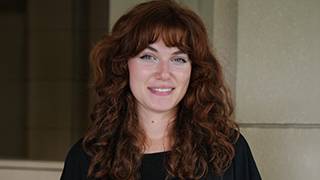
Following this reflection, Fran Malkin shared her recollections of life in hiding, drawing from Years of Horror, Glimpse of Hope: The Diary of a Family in Hiding, written by her surviving uncle. Her testimony was interwoven with personal memories; descriptions of the sacrifices her family was prepared to make, and reflections on the moral landscape of the time, were painful, riveting and profoundly hopeful.
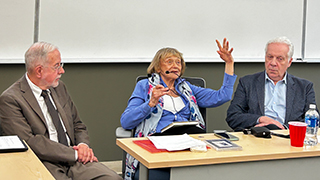
Malkin recalling her experiences
Malkin emphasized that empathy must remain central to Holocaust education. She explained that survivor narratives are among the most powerful and ethically grounded tools available to educators working with difficult history, such as genocide, antisemitism and state-sponsored violence.
Reflecting on themes of identity, resilience and faith, Malkin noted that she has never blamed God for what happened to her, “people did this, and people listen to people.” Her challenge to the audience of future teachers was clear: consider how you will help students confront bigotry, hatred and dehumanization so that future generations, too, will never forget.
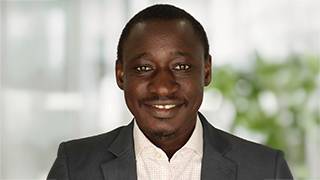
Igor Kotler then spoke and contextualized Malkin’s story with broader patterns of genocide, emphasizing the dangers of institutionalized hatred, the fragility of civility, and the role of educated professionals in enabling the Holocaust. Kotler provided context with warning of antisemitism and other forms of bigotry that continue to reemerge globally.
Students responded strongly to the testimony. Alannis Reyes, a Secondary Education and History student, reflected on the impact of hearing Malkin’s story: “Hearing speaker and survivor testimony is so important and incredibly important to be learned in classrooms. Kids today tend to lack empathy due to the internet, so it’s pivotal for upcoming teachers to continue to teach these stories and prioritize humanizing them for furthered understanding.” She added, “Empathy and resilience were the biggest takeaways for me from this event. Even after everything Fran went through, she didn't blame God; that was very impactful to me.”
View more information about Survivor Fran Malkin.
Watch a documentary about Fran's experience.
About the Center for Global Education
The Center was launched in 2007 within the Department of Educational Studies in the
former College of Education and Human Services (now the College of Human Development,
Culture, and Media). The Centers mission is to advance knowledge of global issues,
build skills and develop dispositions among Seton Hall students, elementary and secondary
school students and domestic and international educators to promote global civic competence.
In addition to a robust relationship with the Borys Grinchenko Kyiv Metropolitan University
in Ukraine, the Center supports University initiatives with the Ukrainian Catholic
University in Lviv, Ukraine.
Categories: Faith and Service, Nation and World