
Matthew Pressman Explores the Rise and Fall of the New York Daily News
Wednesday, October 28, 2026
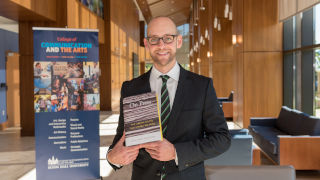
Matthew Pressman, Ph.D.
At its peak, the New York Daily News sold more copies than any other newspaper in American history, shaping public opinion, influencing politics and redefining how millions of Americans consumed the news. In his new book, The People's Paper: The Rise and Fall of the New York Daily News, associate professor Matthew Pressman, Ph.D., explores the tabloid’s history and its enduring influence on American journalism.
Published by Columbia University Press in October 2026, the book traces the Daily News from its founding in 1919 as the nation's first tabloid through its decades of extraordinary popularity, fierce newspaper rivalries and eventual decline. Drawing on previously overlooked historical documents and more than 60 interviews, Pressman examines how the newspaper both reflected and shaped the political, social and cultural transformations of New York City and the nation.
“As a journalism historian, I’ve been fascinated by the history of the New York Daily News for a long time, because it was America’s first tabloid and the highest-circulation U.S. newspaper ever,” Pressman said.
That fascination grew as he uncovered the newspaper’s evolving political identity, its influence on public discourse, its contentious labor relations and its competition with rival publications.
“The way its politics shifted over the years, the influence it had on New York City and the country, labor battles, newspaper wars, the incredible and often shocking coverage—it’s just such a remarkable story.”
Founded as a compact, photograph-heavy newspaper for working-class New Yorkers, the Daily News helped popularize a style of journalism that combined sensational headlines, celebrity coverage and crime reporting with substantive coverage of politics and public affairs. By 1947, the newspaper sold an average of 2.4 million copies on weekdays and Saturdays and 4.8 million on Sundays, circulation figures unmatched by any other American daily newspaper.
The popularity did not insulate the publication from changes in the media industry. As television attracted audiences, New York City’s demographics shifted and competition intensified, particularly following Rupert Murdoch’s acquisition of the New York Post, the Daily News struggled to maintain its dominance.
Pressman’s research chronicles these challenges alongside the newspaper’s editorial accomplishments, political controversies, labor disputes and attempts to reinvent itself for new audiences.
An excerpt from the book, published in Vanity Fair, examines one particularly ambitious, ultimately unsuccessful experiment: the 1980 launch of Daily News Tonight, an upscale afternoon edition meant to attract affluent readers and advertisers. Despite a substantial investment and prominent editorial talent, the venture failed to attract a sustainable audience and closed the following year.
The episode illustrates a central theme of Pressman’s research: the importance of understanding a publication's audience and preserving the distinctive identity that makes it valuable.
For Pressman, the history also challenges assumptions about tabloids' journalistic contributions, which have often been dismissed as sensationalistic or lacking substance.
“Another important finding is that publications that are dismissed as low-brow or sensationalistic can actually still produce a lot of journalistic and civic value,” he said.
Beyond documenting the history of an influential newspaper, The People's Paper offers insights into challenges confronting today's news organizations, including audience fragmentation, changing business models and the struggle to distinguish themselves in an increasingly crowded media environment.
Pressman argues that successful journalism requires more than simply reporting the news. Publications must cultivate a recognizable identity, develop meaningful relationships with their audiences and deliver coverage that readers cannot easily find elsewhere.
“Outlets need a clear voice, identity, and personality—ideally one that’s a little bit fun—and they need to give people something they can’t get anywhere else,” Pressman said.
These lessons also inform Pressman’s teaching at Seton Hall, where he incorporates his research into courses examining the development of American journalism.
In his History of American Journalism course, Pressman has expanded his coverage of tabloid newspapers, including the Daily News, to help students understand how news organizations have adapted to technological, economic and cultural change.
Through these historical examples, students gain a deeper appreciation for the media industry's evolution while recognizing that many contemporary debates about journalism have deep historical roots.
The research helps him demonstrate “how different the media landscape is today than it was in the past but also how many things are actually still the same,” Pressman explained.
Pressman is also the author of On Press: The Liberal Values That Shaped the News (2018). His latest book builds on his scholarship examining the history of American journalism and the relationship between news organizations, politics and society.
By revisiting the rise and decline of America's most widely circulated newspaper, Pressman offers a timely perspective on journalism's continued importance to civic life and the challenges facing news organizations seeking to remain relevant.
Tabloid City: Newspapers and the History of New York
The Seton Hall community is invited to join Pressman and associate professor Sara Fieldston, Ph.D., an expert on New York City history, on Tuesday, November 10, 2026, for “Tabloid City: Newspapers and the History of New York”, a special event featuring a question-and-answer session about his new book and
the history of the New York Daily News.
Attendees will have an opportunity to learn more about Pressman's research, the newspaper's influence on American journalism and the lessons its history offers for today's media landscape.
The People's Paper: The Rise and Fall of the New York Daily News is available through Columbia University Press.
Categories: Arts and Culture