

International Experts Convene for Workshop on Book Written by Professor Margarita Balmaceda
Friday, January 2, 2026
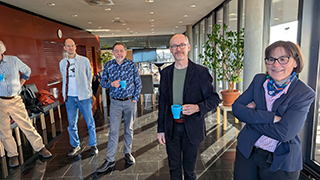 An international group of leading scholars convened for a three-day workshop in Potsdam,
Germany, focused on the first draft of Margarita Balmaceda, Ph.D.’s forthcoming book, The Last Frontier of Decarbonization: Hidden Industrial Carbon between Geopolitics
and Climate Change, currently under contract with Columbia University Press.
An international group of leading scholars convened for a three-day workshop in Potsdam,
Germany, focused on the first draft of Margarita Balmaceda, Ph.D.’s forthcoming book, The Last Frontier of Decarbonization: Hidden Industrial Carbon between Geopolitics
and Climate Change, currently under contract with Columbia University Press.
Hosted by the Research Institute for Sustainability at the German GeoSciences Center, the workshop brought together seven internationally recognized experts from Germany, Sweden, the United Kingdom and the United States to provide in-depth feedback on the manuscript. The institute covered travel and participation costs for the invited scholars, underscoring the project’s relevance to global research priorities at the intersection of climate policy, geopolitics and industrial transformation.
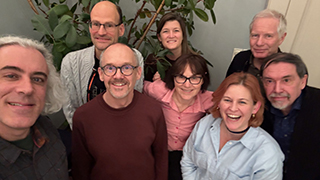
The invited participants represented a wide range of disciplinary and professional perspectives, including academic publishing, energy geopolitics, anthropology, political science and Ukraine and China studies. Among them were Cara Daggett of Virginia Tech, Per Högselius of the Royal Swedish Institute of Technology, Douglas Rogers of Yale University; Emily Channell-Justice, director of the Temerty Contemporary Ukraine Program at the Ukrainian Research Institute at Harvard University, Philip Andrews-Speed of the University of Oxford, and political scientists Peter Rutland of Wesleyan University and Heiko Pleines, vice director of the Institute of Eastern European Studies at the University of Bremen, where Balmaceda also serves as head of the Academic Advisory Board.
Balmaceda said the diversity of perspectives was central to the workshop’s design, noting that each participant represents a distinct readership the book seeks to reach, including policymakers, business leaders, scholars of Eastern Europe and Ukraine, climate researchers and those studying China’s role in the global economy.
“This book is important because it shows that the ‘hidden’ use of fossil fuels as feedstock or in industrial chemical reactions, as in steel, plastics and nitrogen fertilizer production, for example, not only has serious implications for the climate, but is also crucial for unlocking broader decarbonization processes,” Balmaceda said. “The book is also important because it bridges the gap between highly technical research and concrete policy concerns, providing readers with the necessary technical understanding to participate actively in debates.”
According to Balmaceda, participants' responses were enthusiastic, with discussions highlighting the book’s potential to reshape how industrial carbon use is understood in both academic and policy circles. She recalled a particularly affirming comment from Högselius, who emphasized the manuscript’s relevance beyond academia: “People from industry will take this book very seriously.”
Channell-Justice emphasized the book’s contribution to rethinking energy politics in a changing global landscape.
 “The book makes a major contribution to the way we have understood—and misunderstood—energy
politics, specifically around the global shift away from fossil fuels,” Channell-Justice
said. “This book helps us understand how carbon is used in far more ways than just
for direct energy consumption, and it also shows how this usage is tied up in major
geopolitical interests.”
“The book makes a major contribution to the way we have understood—and misunderstood—energy
politics, specifically around the global shift away from fossil fuels,” Channell-Justice
said. “This book helps us understand how carbon is used in far more ways than just
for direct energy consumption, and it also shows how this usage is tied up in major
geopolitical interests.”
The Research Institute for Sustainability and the German GeoSciences Center are part of the Helmholtz Association, Germany’s largest research organization, with an annual budget exceeding $6.5 billion. The Helmholtz Association’s mission focuses on research that addresses major, pressing questions facing science, society and industry, aligning closely with the themes of Balmaceda’s work.
Balmaceda said the workshop marked an important milestone in the book’s development, while also making clear that substantial work remains ahead. She noted that the depth and rigor of the feedback reinforced the project’s core premise: that addressing industrial carbon use is essential to any serious global decarbonization strategy.
Margarita Balmaceda, Ph.D., is a founding faculty member in the School of Diplomacy and International Relations and a leading expert in the political economy of energy.
Categories: Nation and World, Research