
Diplomacy Alumnus Lights Up Geopolitics and AI Strategy
Wednesday, February 25, 2026
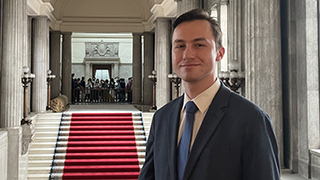
Anthony J. Tokarz '19 visiting the Japanese National Diet Building.
Anothony J. Tokarz '19 is making waves in the world of geopolitical risk and emerging technology as a special projects associate at Anadyr Horizon, an AI-driven geopolitical risk intelligence startup that is pioneering Agentic Systems Intelligence (ASI) to build predictive simulations of geopolitical risk scenarios. At Anadyr Horizon, Anthony leads go-to-market strategy and client-facing engagements in addition to supporting the development of simulation intelligence tools for use in the government and financial services sectors as they navigate global crises and strategic shifts. Anadyr Horizon’s work blends geopolitics, national security, defense and emerging technologies — placing Anthony at the forefront of analytical, policy and commercial innovation.
In his role, Tokarz balances go-to-market strategy with deep geopolitical analysis. He organizes and leads technology demonstrations for clients while tracking trends in defense tech, Department of War policy and strategic developments in regions like the Arctic and Indo-Pacific. Behind the scenes, he supports senior leadership by drafting briefings and memos, preparing for high-level meetings with defense and diplomatic stakeholders and framing how geopolitical risk influences capital allocation and industrial policy.
His professional journey reflects a commitment to understanding power and strategy across sectors. During his time at Seton Hall University’s School of Diplomacy and International Relations, he built a portfolio of internships that spanned international institutions, private industry and government despite graduating in three years. He later pursued graduate studies at Columbia University’s School of International and Public Affairs, where he expanded his expertise in political, economic and security analysis. While there, he also had the opportunity to reconnect with Professor Anne-Marie Murphy, a professor at the School of Diplomacy and adjunct research scholar at the Weatherhead East Asia Institute.
Early on, what set Anthony apart was a focus on analytical writing, regional focus and a curiosity about how institutions function in the real world — skills he nurtured at Seton Hall and sharpened through internships connected to the United Nations and other global organizations. This skillset served him in completing a Marcellus Policy Fellowship at the John Quincy Adams Society in Washington, D.C., where his final report outlined a regional strategy for modernizing NATO while recalibrating burden-sharing.
For current and prospective Diplomacy students, Tokarz offers practical advice: treat international affairs as a craft, not just an academic subject. Build sound judgments, learn how institutions work in practice and communicate concisely, especially under pressure. He encourages students to broaden their exposure to different sectors, connect with professionals through outreach and networking, and pursue experiences that expand their “surface area” for opportunity.
Tokarz said,
My best advice to current Diplo students is to balance a strategic understanding of the geopolitical landscape with deep expertise in a specific region — mine were Central-Eastern Europe and Russia — and an analytical method — mine were OSINT and supply chain analysis. Also, remember that economics is the language of politics, so I recommend taking as many courses as possible in economics to understand how world leaders — and, hopefully, your future principals — think through and assess the decisions they have to make.
He credits Seton Hall’s Catholic values with helping him understand human nature to navigate institutions more effectively by focusing on constraints, incentives and political considerations. He is also grateful for the Seton Hall professors, most notably James Kimble, who encouraged him to submit his work for publication. This led to bylines in The National Interest, Eurasianet and Responsible Statecraft, among others. By combining regional expertise and analytical depth with strategic, cross-sectoral engagement, Anthony demonstrates how a Diplomacy foundation can lead to impactful work at the nexus of global strategy, technology and policy.
Categories: Nation and World, Science and Technology