
Tarasenko-Struc Advances Whole-Person Education Through the Medical Humanities Program
Thursday, January 15, 2026
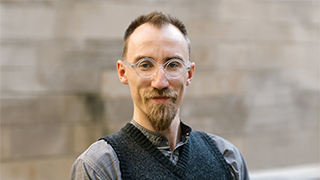
Aleksy Tarasenko-Struc, Ph.D., Assistant Professor of Philosophy and Director of the Medical Humanities Program
Aleksy Tarasenko-Struc, Ph.D., Assistant Professor of Philosophy in the College of Arts and Sciences and director of the Medical Humanities Program, has recently authored a series of articles in top-tier academic venues. His recent publications include “Dehumanization: From Ethics to Metaphysics (and Back)” in the European Journal of Philosophy; “Purely Performative Resuscitation: Treating the Patient as an Object” in Bioethics; “Can People with Severe Disorders of Consciousness Be Wronged?” in Neuroethics; and “Animalization” in The Philosophical Quarterly, among others. He completed his Ph.D. in Philosophy at Harvard University. Formerly a clinical ethics fellow at Albany Medical College, he pursued bioethics research, taught and conducted clinical ethics consultations.
When asked what unifies these articles, Tarasenko-Struc points to a central theme: dehumanization. “They are each about a different facet or different form of dehumanization, but that’s one thing that they have in common.” Tarasenko-Struc stresses that this phenomenon, which often manifests as treating others as objects or as if they were invisible, is more than just psychological; it is deeply moral.
Building on that ethical starting point, Tarasenko-Struc suggests that taking dehumanization seriously can, in turn, sharpen moral philosophy itself. “I think it can also enhance our repertoire of conceptual tools,” he adds, “so it can, in that way, change the way we think about morality.” The same throughline carries into his teaching. “Some of my research does shape the way I approach the course I teach,” he notes.
Tarasenko-Struc teaches biomedical ethics at multiple levels, from introductory courses to advanced offerings. As the spring semester begins, he is taking students further into real-world settings where ethical questions don’t stay theoretical. “I’ll be teaching a more advanced course in biomedical ethics that has an experiential learning component, requiring students to go to healthcare sites and actually observe providers working in the field.”
Those human elements also extend beyond the classroom and into the broader academic community he is building at Seton Hall. “Another one of my responsibilities at Seton Hall is directing the Medical Humanities Program, and it’s something I’m very proud of,” he says. When he inherited the program, there were seven students pursuing a Medical Humanities Minor. Now, he says, “as of the other day, we’re up to 32. So the program is really growing. It’s growing strong.” He credits the program’s growth to broader institutional support and to steady, ongoing work behind the scenes, as the curriculum continues to evolve in response to students’ needs and interests. “We’ve redesigned the curriculum to make it easier for students to find really interesting and helpful courses,” he says, noting that the process is iterative and continually evolving.
For students headed toward healthcare, he calls the program “a fantastic choice,” in part because “it gives them a new set of lenses to bring to their calling as healthcare workers,” including “a lens specifically informed by ethics and the humanities more broadly.” “I’m honored to direct it,” he adds, “and I’m continuously working to cultivate it and expand it.”
Asked what that lens offers students in practical terms, Tarasenko-Struc puts it plainly. “It helps students by giving them a deeper, more reflective and more nuanced view of health and healthcare,” he says. “Healthcare cannot just be a matter of technical expertise,” especially “because as a healthcare worker, you are caring for people, for human individuals.” That care requires a broader understanding of the person in front of you. “You have to understand not just the biological and chemical facts about people, but also a range of social facts,” he says. “And you must have a sense of what the right thing to do in various situations might be.”
That humanistic grounding, he adds, can translate into tangible advantages for students as they pursue and enter the profession. “For example, medical students have to go through a grueling interview process where they’re asked questions about the ethics of different healthcare practices like physician-assisted suicide, end-of-life decision-making and situations where patient autonomy conflicts with clinical judgement, among other ethical issues,” he says. Those who have done that work early, he emphasizes, tend to be at an advantage. “Students who take a course like mine, or who more generally have a complex, well-thought-out view of the ethical and social aspects of healthcare, do a much better job in those interviews,” he adds. “That preparation proves increasingly important in a highly competitive selection process.”
In all these ways, Tarasenko-Struc’s work embodies the very essence of Seton Hall’s promise: Inspiring Great Minds to Greater Purpose. By challenging aspiring healthcare professionals to see the human being behind the diagnosis, he offers an education that cultivates not only intellect, but also character and humanity. As these students step into their careers, they carry with them the spirit of Hazard Zet Forward, moving boldly into the future with the courage to care, the wisdom to act and the character to make a difference as whole persons.
Categories: Education, Health and Medicine, Science and Technology