
Seton Hall Students Tour Arthur Szyk Exhibit at the Museum of Jewish Heritage
Tuesday, April 21, 2026
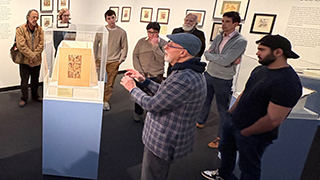
Irvin Ungar explains the history behind one of Szyk's pieces.
On March 12, 2026, Seton Hall students travelled off campus and into New York City for an art exhibit tour at the Museum of Jewish Heritage. Titled "Art of Freedom: The Life and Work of Arthur Szyk," the exhibit displays a wide-ranging selection of pieces from Szyk, a Polish-American and Jewish artist who not only created anti-fascist propaganda during World War Two but also advocated for human freedom as a whole.
Students had the privilege of receiving a personal guided tour from Irvin Ungar, who has dedicated his life to spreading knowledge of Szyk’s work. As they observed Szyk’s intricate illuminations and illustrations up close, students listened to Ungar describe the history and meaning behind each piece.
Born to a Jewish family in Łódź in 1894, Szyk moved to Paris at age fifteen to study art. In 1940, Szyk and his wife left Europe amidst the rising threat of Nazism and ultimately settled in Connecticut. Throughout World War Two, Szyk created political art that caricaturized the Axis powers and attacked antisemitism. His work appeared nearly everywhere, from magazines to postcards to buildings. Following the conclusion of the war, he continued to view himself as a “soldier in art” and harnessed the power of visual expression to promote freedom in all forms.
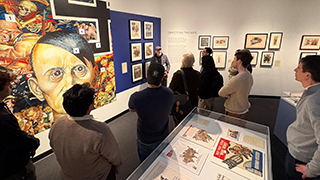
Students observe a blowup of Szyk's "Anti-Christ," produced in 1942.
Students were accompanied on the trip by School of Diplomacy and International Relations Professor Brendan Balestrieri and visiting Fulbright scholar Łukasz Kamieński, Ph.D. The tour was part of a series of experiences from March 11-14 that connected lectures, research workshops and a NATO crisis simulation. During that time, Seton Hall hosted Kamieński, who is from Jagiellonian University in Kraków, Poland.
Kamieński reflects on his experience at the exhibit saying,
Although I had known about Arthur Szyk before, visiting his exhibition with Seton Hall students and faculty, along with the exceptional private tour by Irvin Ungar, gave me a much deeper understanding and appreciation of his artwork and its historical significance. I was especially struck by how his Polish roots, Jewish identity and fear of totalitarianism shaped his work both before and after he emigrated to America. I was impressed by how much his art serves not only as a powerful anti-authoritarian statement but also as a profound defense of freedom, dignity and justice, often challenged even in democracies. The trip will stay long in my memory.
The exhibit’s impact highlights a founding goal of The Serviam Institute for International Security (SIIS), which was a main organizer of the trip and March 11-14 experiences. The Serviam Institute aims to provide impactful, first-hand learning experiences for students interested in international relations and security policy.
According to Balestrieri, director of The Serviam Institute,
Providing opportunities for students to make connections between what they are learning in the classroom and in their community is what the Serviam Institute is trying to accomplish.
After the tour’s conclusion, students returned to Seton Hall, but not before stopping for a bite to eat at the World Trade Center, where they discussed their recent experience over a shared meal and reflected on Arthur Szyk’s continuously influential artwork.
Categories: Arts and Culture, Nation and World