
Oslo Freedom Forum Inspires Recent Diplomacy Graduate
Thursday, August 27, 2026
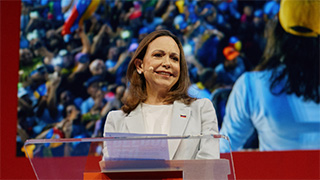
The main stage at the Oslo Freedom Forum, where nearly 1600 people from 111 countries gathered in Oslo, Norway with one shared purpose: Dismantling Dictatorship.
I arrived in Oslo on the first day of Pride Month. I couldn’t imagine a better city to be in. Rainbow flags were wrapped around every lamppost, potted plant and building. No matter how architecturally diverse, Norwegians found a way to show their pride.
Immediately after stepping off the plane, I sensed a difference in culture. The air felt lighter. Maybe it was the breeze of healthcare that’s free in Norway. It was a calmer, quieter country than I had expected.
Traveling on a high-speed train, I reached the city center which was about 15 minutes from my hotel. Of course, the first building I encountered as I came up from the underground was a beautifully baroque McDonald’s. I felt right at home.
I found myself in Norway by chance — by fate — quite literally. A smaller version of the Oslo Freedom Forum, entitled the College Freedom Forum, had come to Seton Hall, a few months earlier. An international relations student, I attended out of my interest in global affairs. While I was at the forum on campus, I put my name into a metaphorical hat for a chance to win a free trip to Norway to attend the Oslo Freedom Forum. When the winners were announced, my name was called. Yippee!
Thanking fate for bringing me to Oslo, I looked around. There were people everywhere. Some were taking advantage of the limited sunlight of the season. Drinks in hand. Dining in restaurants along the street. As my suitcase click-clacked along the cobblestone street, I noticed other people standing in long lines stretching into the park where people waited at food stands shaped like miniature gazebos. Other park goers were standing on the grass under a tree tunnel. Everyone seemed to be watching a giant video screen showcasing the event I was about to attend, the Oslo Freedom Forum.
As I came to learn, the Oslo Freedom Forum is an international human rights conference that brings together activists, journalists, students, artists, technologists and policy makers from around the world. Hosted by the Human Rights Foundation, the forum gives people a direct platform where they can talk openly about the challenges they and others face each day under authoritarianism. And together, look for ways to advance human rights, democracy and individual freedom.
On my first day in the city, I got lost and ran late for the opening of the Forum. Unfamiliar with Norwegian streets, I found myself at the wrong address. A very kind woman helped me out after I'd gotten the directions wrong twice. Though panicked, she put me at ease. Most Americans I know would have sped past me as if I were a basket case.
I raced to the venue, which turned out to be the most ornate building I had ever seen. Konserthus concert house was modern, yet entirely elegant. Stepping inside, I immediately felt refreshed. Konserthus welcomed inspiration in a delicate way. It was perfect for a conference of this caliber.
As the Oslo Freedom Forum got underway, everyone filed into a spacious auditorium, took their seat and got ready for about four hours of presentations focusing on human rights. The speakers weren’t simply reading off their slides. They were heartfelt and exceptional. The presenters connected with the audience with confidence and clarity. Together they were an engaging mix of activists, reporters, philanthropists, tech innovators, freedom fighters, rappers and just regular people with the courage to speak out in support of human rights.
Some of my favorite speeches were given by Yirgalem Fisseha, an Eritrean writer and poet; Mohammad Al Abdallah, a Syrian human rights lawyer; and Lobsang Sangay, the former president of the Tibetan government in exile.
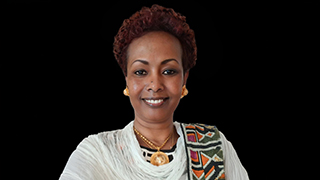
Audiences at the Oslo Freedom Forum heard from Yirgalem Fisseha, a highly acclaimed Eritrean writer and former political prisoner.
Fisseha has been a poet since she was very young. After the Eritrean regime’s ban on independent media in 2001, Fisseha joined Radio Bana, a broadcast station owned by the Ministry of Education. In 2009, the regime blocked and dismantled Radio Bana and arrested all of its staff. Fisseha spent more than five years in military prisons, enduring unspeakable torture for the crime of wanting to write freely and contribute independently.
After her release, she tried to escape from Eritrea, but was eventually caught and detained again in 2016. Imprisoned for four months, she finally escaped in 2018.
Fisseha spoke about her family and the pain of having to flee the country she loved. She spoke about her brothers who were also forced to leave the country and the possibility that she will not see them again. As I listened to her story unfold, I could feel the anger and the pain bleeding through her words. All that Fisseha had endured, just because she wanted to speak freely. Fisseha ended her presentation with one question: “What would you do?”
Mohammad Al Abdallah’s speech was equally heart wrenching. He was imprisoned two separate times in Syria by the Assad regime for working to defend human rights. During his imprisonment, Al Abdallah experienced brutal torture, some of which he described while on stage in Oslo. It was chilling. Equally compelling was his experience with his father.
Al Abdallah explained that while he was growing up, his dad had been a dissident writer in Syria. He was repeatedly arrested for his work, and tortured. There were years of Al Abdallah’s life where he wasn’t able to see or talk to his father and wondered if he was even alive. He found out what happened to him while he himself was in prison. Eventually Al Abdallah was reunited with his father who was being held the same cell block. Father and son were together, but at the expense of their freedom.
Near the end of his presentation, Al Abdallah talked about his own son, who he is raising in the United States. He shared his fears that passing along his language, culture and history might be unsafe for them. He grieves over the fact that his son will never be able to experience the Syria he once knew. As his speech came to a close, Al Abdallah shared a slide with two images. On one side, was a picture of him and his father taken in prison. Alongside that image, a second photo depicted Al Abdallah fishing with his son. Al Abdallah said he wants to see a future in Syria where fathers and sons can experience tranquility together and go fishing and enjoy other activities. He does not want a Syria in which the only time fathers and sons are reunited is when they are locked in a cell, scared and confused. His voice was cracking, but remained strong, as he wept.
Finally, Lobsang Sangay’s presentation offered a refreshing shift. After hours listening to painful testimony about torture and other severe human rights violations, it was a relief to hear a different perspective on the world’s human rights crisis. It was short and straight to the point.
Sangay walked onto the stage with a clear message. He shared it in just five slides and five statements. That was it.
Sangay is a lecturer at Harvard but previously held the role of the democratically elected president of the Tibetan government in exile. Sangay used humor and a powerful mission statement. He told the audience: “You can’t just dismantle dictatorships. You need to replace them. In other words, you need to check abuses of power and crush authoritarianism while simultaneously creating structures and systems to lift society up.”
Day two of the conference focused on technology. Maria Corina Machado gave an empowering speech at the Konserthus. Actor Richard Gere spoke briefly before presenting the Vaclav Havel International Prize for Creative Dissent to Chinese contemporary artist Gao Zhen and Burmese dissident artist and curator Sai Redacted.
Afterwards, everyone traveled to the conferences’ second location — Transformator
Scene. The venue was a combination warehouse and church, complete with sparkling clean,
grass-themed unisex bathrooms. The program there consisted of AI talks about how to
best work this sparkly new
technology into the world of activism in order to make change.
During my time at the Oslo Freedom Forum, I met other students through the program coordinator and just by mingling and networking. I did my best to take advantage of the three days I spent in Norway. By the end of my trip, I had a small network of my own! I met students from Tufts University and even connected with a friend from Seton Hall! It’s such a small world.
Programming on the third day of the conference was the most impactful for me. I attended a panel on the future of democracy in the Middle East. Another talk featured journalists working in authoritarian countries, who spoke about reporting under extreme duress. Two sports journalists and a FIFA referee debated whether the World Cup is good for democracy, or not.
The Human Rights Foundation closed the conference with a short comedy show. Three comedians, representing three different parts of the world — China, Indonesia and Yemen/Ethiopia — lifted everyone’s spirits
The Forum came to an end with a party celebrating the efforts of all those who had planned, presented and attended the 2026 Oslo Freedom Forum. It was an incredible room to be in. A quote came to mind that night: “There is much pain in the world, but not in this room.”
That is exactly how it felt. Survivors, scholars and scientists, politicians, philanthropists and powerhouses all in one room, dancing to a Norwegian DJ playing his harmonica. It was surreal.
This trip was a once-in-a-lifetime experience. Winning a random raffle gave me a chance to expand my knowledge into areas I had never considered. It opened my eyes and pushed me to reckon with the ease of my freedom, and the lack of freedom that others face. How can so many people in the global north take our privileges for granted? I guess because we’re not used to questioning it.
My thanks go out to the Human Rights Foundation for inspiring me to question the world around me. I am grateful to HRF for letting me become an advocate for those who don’t have the freedom to ask "Why?"
Categories: Alumni, Arts and Culture, Nation and World