
School of Diplomacy Hosts Chemi Lhamo: A Tale of Dedication to Human Rights and Free Tibet
Tuesday, March 24, 2026
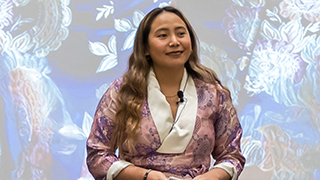
Chemi Lhamo delivering her keynote address
On February 20, the School of Diplomacy welcomed Tibetan-Canadian human rights activist Chemi Lhamo to the College Freedom Forum, organized by the Human Rights Foundation (HRF). This was a historic moment for the University, uniting future human rights advocates, including Lhamo, who are inspiring youth and others around the world. Participants discussed Tibet's ongoing fight for freedom and sovereignty amid repression by the Chinese Communist Party.
Hosted in Bethany Hall, the event brought together students, faculty, HRF officials and distinguished guests from the field of diplomacy. The atmosphere blended concern about the oppression affecting millions of people around the world, with hope for the future of Tibet and other nations where human rights are suppressed under authoritarian regimes.
Neve Walker, an undergraduate student at the School of Diplomacy, shared her excitement about meeting Lhamo,
My biggest takeaway from the talk and also interviewing her beforehand is that we as global citizens have the duty to stand up for what’s right and not to contribute to exploitative systems. As civil society actors, as well as students, it is our job to give a voice to those who are voiceless and educate ourselves on pressing issues. Chemi Lhamo was an individual who inspired me to think about my everyday actions and how they contribute to global systems.
The afternoon began with an introduction by Dean Courtney Smith, Ph.D., who reflected on the School of Diplomacy’s commitment to human rights and its mission to prepare students to build democracy and social justice around the world. Following Dean Smith, Malaak Jamal, director of Policy and Research, HRF and alumna of the School of Diplomacy, introduced Lhamo.
“Free and Home,’’ she said, beginning her keynote address. “Concurrently, it can not exist for Tibetan people.” Living in Canada, Lhamo is a Tibetan who always wonders what home looks like. She emphasized the story of many other Tibetans who do not know what home looks like because they were displaced, their rights were violated and their cultures were suppressed.
Lhamo explained how this advocacy shapes her life and she strives for freedom despite the brutal rape and death threats she receives. Her story echoes the work of every brave young human rights activist who works for justice, no matter the struggle and continues to inspire others. Lhamo is a living testimony of resistance against patriarchal authoritarian regimes.
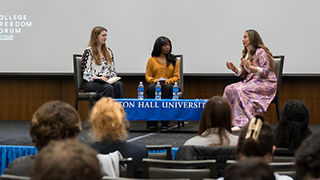
Fireside chat moderated by Diplomacy undergraduate student Esther Edohwokui and graduate student Ryan Campbell
Following Lhamo’s presentation, the forum continued with a fireside chat moderated by diplomacy undergraduate student Esther Edohwokui and graduate student Ryan Campbell. The fireside chat explored Lhamo’s personal journey into human rights advocacy. Throughout the session, Lhamo reflected on the historical root causes of the Tibetan people’s displacement and the strategic political plans behind it. Lhamo explained how Tibetans are forced to watch while the economic benefit from the land’s resources flows right out of their country.
One of the main takeaways from the session was the importance of the international community and international solidarity in promoting human rights, especially in the face of political suppression. Lhamo emphasized the vital role of storytelling and civic engagement and noted that universities serve as a critical space for awareness and advocacy. Her remarks underscored the starting point of her journey. A few years ago, in a university dorm room, she made an endless effort to organize student activities on campus to spread Tibetan stories. Since then, Lhamo has been actively fighting for Tibet's freedom and sovereignty.
Students had the chance to interact with Lhamo during the Q&A section of the forum. Participants asked about how grassroots organizing can shape the process for freedom and democracy, the ethical responsibilities of third actors, international organizations and the role of gender in human rights activism. An interesting question posed to Lhamo, ‘’What does home mean to you?’’ Lhamo replied, ‘’Home is shared humanity.’’
Lhamo continued,
Home feels like a place where you feel safe and loved. I struggled throughout my life to find where home is, traveling through Tibet, India, Canada and the US. As I grow through activism, I realize that home isn’t just a physical space; it can be a stage where I share the power of being together, connected and advocating for democracy. We are breathing the same air, sharing this moment together. Millions of things come together to make this shared moment and it is happening. For me, this is a symbol of shared humanity.
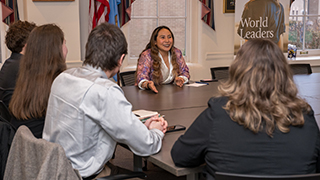
Small group discussion between diplomacy students and Lhamo in the Diplomacy Room at McQuaid Hall.
The forum concluded with a small group discussion between diplomacy students and Lhamo in the Diplomacy Room at McQuaid Hall. Lhamo advises students who aspire to human rights activism and similar paths to never be afraid and to remember their responsibility to fight for everyone’s freedom.
The School of Diplomacy and HRF collaborated on this inspiring event, bringing together students and Lhamo’s story of dedication to human rights to the heart of campus, where current and future leaders directly engage, inspire and learn from each other.
Categories: Campus Life, Education, Faith and Service, Nation and World