
From Bearing Witness to Building Change: Kathryn Striffolino Brings Humanitarian Diplomacy to Seton Hall
Wednesday, November 4, 2026
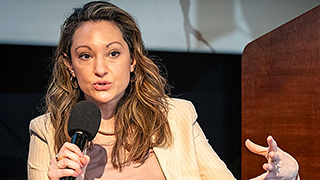
Kathryn R. Striffolino
Early in her career, Kathryn R. Striffolino stood alongside an Indigenous farming community in southern Mexico and learned a lesson that would shape the course of her professional life.
Striffolino, now the Tom and Ruth Sharkey Distinguished Visiting Scholar at Seton Hall University’s School of Diplomacy and International Relations, was participating in unarmed protective accompaniment with Witness for Peace. As the mission came to an end, one of the farmers who had hosted her group made a simple request. “Please tell everyone what is happening here,” he told them. “We can’t, but you can.” For Striffolino, the words carried a responsibility that extended far beyond that moment.
“Our job was to remain physically present alongside people whose human rights work put them at risk,” she said. “That experience taught me that presence, careful attention, and bearing witness can influence what armed actors are willing to do and help protect civilians.” It also taught her something about her own position in the world, that privilege could be used deliberately to support people whose voices might otherwise go unheard.
Beyond the Policy Document
That early experience ultimately developed into a career at the intersection of humanitarian
action, diplomacy, advocacy and civilian protection. Striffolino has supported and
led access- and protection-centered dialogue and negotiations in places including
Myanmar, northwest Syria, Iraq, Colombia, Afghanistan, Sudan, Mexico, Haiti and Turkey.
Her work has involved engaging with governments, de facto authorities and non-state
armed groups in environments where the consequences of diplomacy are not theoretical.
Policy documents often present concepts such as humanitarian access, protection and human rights as things that are simply granted or denied. Striffolino said the reality is far more complicated. One of the most important lessons she has learned is that civilians living through conflict are not simply waiting for outsiders to solve their problems. For diplomats and policymakers, listening to those decisions is only the beginning. The challenge is turning them into action.
“Words on paper mean nothing unless people in power act,” she said.
Finding Common Ground, Even When There Is Little
Striffolino’s career has also required her to sit across the table from people whose
beliefs, priorities or perceptions differ dramatically from her own. Her approach
begins with a distinction that she believes is essential to diplomacy, listening does
not mean agreeing.
“You cannot move someone whose interests and constraints you have not taken the trouble to understand, and that understanding can make or break a diplomatic initiative,” she said.
Striffolino has encountered discrimination related to her gender, age and nationality while negotiating and has learned that maintaining composure is, in and of itself, a professional skill. Her advice to future diplomats includes practicing those skills constantly, along with perfecting a good “poker face.”
Bringing the Field Into the Classroom
Now, Striffolino is bringing lessons from those experiences into the classroom at
Seton Hall. This fall, she is teaching The Art and Science of International Negotiation,
where she asks undergraduate students to confront live policy, humanitarian and human
rights dilemmas rather than learning exclusively from settled case studies.
Her goal is not simply to teach students what diplomats have done before them. She wants them to develop skills they can use when they encounter problems for which there is no established answer.
“I want them to leave the course with transferable, immediately applicable skills and knowledge that will help them succeed in these fields,” she said.
For students hoping to follow a similar path, Striffolino offers advice that may sound unusual in a culture where young professionals are often encouraged to map out every stage of their careers. Instead, she encourages students to stay open to unexpected opportunities.
“Make connections, foster relationships, pursue internships, say yes to opportunities even if you’re nervous or scared, push yourself, and explore what genuinely interests you,” she said. Her message to students is also that diplomacy cannot be mastered through theory alone.
“Diplomacy is a learned craft,” she said. “It’s not something you can learn overnight.”
A Field That Needs the Next Generation
For Striffolino, students are entering international affairs at a moment of profound
change. Technology and artificial intelligence are reshaping the tools available to
diplomats and policymakers, while emerging global challenges increasingly strain traditional
frameworks. Rather than seeing that uncertainty solely as an obstacle, Striffolino
sees an opportunity for the next generation.
Today’s students may recognize problems that established systems fail to capture and develop solutions that previous generations could not have imagined. Their fluency with emerging technologies, including artificial intelligence, may also allow them to approach diplomacy and humanitarian action differently. Decades after an Indigenous farmer in Mexico asked her to tell others what was happening, that responsibility continues to shape Striffolino’s work now not only through negotiations and humanitarian advocacy, but through the students who will eventually take their own seats at negotiating tables.
Her advice for facing work that can sometimes seem impossibly large is simple.
“When you are stuck, find the other helpers,” Striffolino said. “One person cannot solve the world’s problems, but others are working just as hard. Find them and make them your people.”
Categories: Nation and World