
Inside the Core: Romero-King Week
Tuesday, March 31, 2026
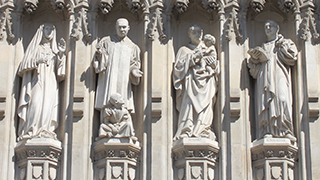
Romero and King on Westminster Abbey, London, UK
This time every year, the University Core honors two heroes of faith and social justice –Saint Oscar Romero and Martin Luther King, Jr. On March 24, the anniversary of Romero’s martyrdom at the altar in 1980, the first of two Romero-King Vigils-on-the-Green was conducted. The second will be on April 7, also on the green, at 1 p.m. Normally, the Core tries to have the closing event on or near the date of King’s assassination on April 4, 1968. This year, however, April 4 is Holy Saturday, the day before Easter Sunday, and the University will be on break. The “week” – or slightly more – in between these two vigils is dedicated to both men, and this year there are two special events during this period.
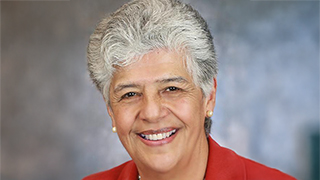
Ana Maria Pineda, Ph.D., author and professor at Santa Clara University
On March 31, the Core will be pleased to host Ana Maria Pineda, Ph.D., of Santa Clara University on Teams to speak about Father Rutilio Grande, the close friend of St. Oscar Romero, whose death impacted him to become more proactive regarding abuses by the Salvadoran government. Pineda is related to Rutilio Grande and is an expert on his life and impact on El Salvador and St. Oscar Romero. Rutilio Grande was beatified by Pope Francis in 2020.
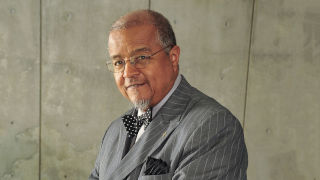
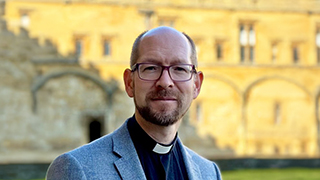
Reverend Forrest Pritchett
On April 1, 9-11 a.m. in the Event Lounge in the University Center, Reverend Forrest Pritchett (with the Core) will host a very special breakfast in honor of Romero and King. This will be an important time of reflection on the two heroes. For more information and registration, use the calendar link attached. All are welcome, but registration is necessary.
On a related note, Nancy Enright's Core II class read Harriet Jacobs’ Incidents in the Life of a Slave Girl, as Told by Herself, in which she tells of her experience growing up as a slave, forced to endure sexual and other abuse and, in order to escape, for a time separated from her children. Once she gained her freedom, having fled to the north, she was subject to arrest under the Fugitive Slave Act, passed in 1850. This immoral law made the “free” north a dangerous place for escaped slaves.
Jacobs tells of an abolitionist friend, Mrs. Bruce (her name in the book, changed for safety reasons), who helped her to avoid detection. This woman had a relative, who warned her against helping Harriet (called Linda in the book, again for safety reasons) as she was risking arrest and, as he put it, “going against the laws of her country” and asking if she were aware of the penalty (prison). Mrs. Bruce responded, “I am very well aware of it. It is imprisonment and one thousand dollars fine. Shame on my country that it is so! I am ready to incur the penalty.” In the class discussion of the text, a student pointed out the difference in the responses of the two individuals and the significance it showed in their characters.
This text by Jacobs (particularly this incident) relates to both Martin Luther King, Jr. and St. Oscar Romero. Both focused on the need not only to agree that something is evil but to take action, non-violent action in both cases, against it, even at the risk of arrest or other personal harm, to the point of death.
In King’s “Letter from the Birmingham Jail,” where he was placed as a result of leading of protests in Alabama in 1963, he argues that in the case of an unjust law, such as racist laws and other injustices in the 1960s or the Fugitive Slave Act of 1850, one can be obligated, in fact, to disobey the law, risking the consequences. King says, “One may well ask: ‘How can you advocate breaking some laws and obeying others?’ The answer lies in the fact that there are two types of laws: just and unjust. I would be the first to advocate obeying just laws. One has not only a legal but a moral responsibility to obey just laws. Conversely, one has a moral responsibility to disobey unjust laws. I would agree with St. Augustine that ‘an unjust law is no law at all.’"
Similarly, St. Oscar Romero made a similar point in his plea to members of the National Guard and others in the military, who were being told to arrest and even sometimes to torture and kill people deemed a threat for their activism or even their verbal defense of human rights. On the night before his death, he said: “I would like to appeal in a special way to the men of the army, and in particular to the troops of the National Guard, the police, and the garrisons. Brothers, you belong to our own people. You kill your own brother peasants; and in the face of an order to kill that is given by a man, the law of God that says ‘Do not kill!’ should prevail” (Ignatian Solidarity Network). It is widely believed that this statement may have been the very catalyst that led to Romero’s death while saying Mass the following morning.
As the community remembers St. Oscar Romero and Martin Luther King, Jr., the Core holds fast to the legacy of courage, faith, and sacrifice they represent and acknowledge how even they themselves were carrying on the legacy of their forebears, such as Harriet Jacobs, St. Augustine, and many prophets and saints over the centuries.
Categories: Faith and Service, Nation and World