
Inside the Core: Film Series Presentation
Monday, February 2, 2026
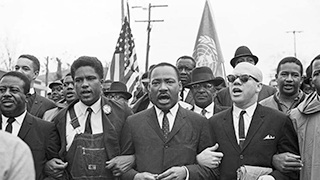
Dr. Martin Luther King Jr. leading the March from Selma to Montgomery
Inside the Core is pleased to present the first in its film series for the spring semester, Selma, about the famed march from Selma to Montgomery led by Martin Luther King, Jr. The film will be introduced by Reverend Forrest Pritchett. There will be an opportunity for questions and answers afterward, along with light refreshments. The film will be shown on Wednesday, February 4 at 2 p.m. in the Core Center, Mooney 339.
The other films in the series will be: Roses in December, about the four women killed in El Salvador in 1980 (February 24); Cabrini, about Saint Frances Xavier Cabrini, patron saint of immigrants (March 17); and Triumph of the Heart, about St. Maxmillian Kolbe, Polish priest who died in Auschwitz (April 30). All the films, like Selma, will be at 2 p.m. in the Core Center with an expert to introduce them and to take questions at the end. Light refreshments will be served at all showings.
Each of these films focuses on an individual or group who chose to say “no” to evil. In most cases, it cost them their lives. These films were not randomly chosen but link carefully with the themes and values taught in the University Core.
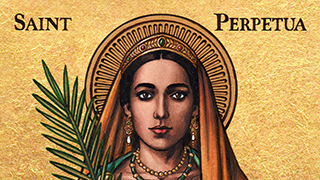
St. Perpetua, young martyr of North Africa, 203
For one example, in Core II most classes are covering the early Christians right now. In the story of Perpetua, the young North African martyr who died during the reign of Septimius Severus in 203, one sees her refusal to offer sacrifice to the gods in honor of the emperor’s son’s birthday, leading to her death and that of her companions who similarly refused. Much pressure was put on her by the local governing officials and even by her own father, who urged her to recant. Her reply to him, “I am a Christian” – “Christiana sum” – summed up her identity, which precluded participation in something evil (idolatry, in this case). Her “no” to the demand to sacrifice led to her death in the arena with other martyrs.
Similarly, in Roses in December, one sees the story of three sisters (Ita Ford, Maura Clarke, and Dorothy Kazel) and laywoman Jean Donovan, who said “no” to the injustices occurring in El Salvador (and which led to the earlier death the same year, 1980, of St. Oscar Romero). They were martyred, and the 45th anniversary of their deaths fell on this past December 2. In Cabrini, onewe sees the story of St. Frances Xavier Cabrini, who was sent by Pope Leo XIII, to work with Italian immigrants in 19th century New York City. Her “no” to the prejudice and cruelty experienced by the people she was sent to serve led to enormous works of mercy (in the form of orphanages, schools, hospitals, etc.) that spread throughout the US and beyond. Finally, in Triumph of the Heart, one sees the powerful story of St. Maxmillian Kolbe, who said the ultimate “no” to the Nazi terror, as it singled out individuals in the camp, often randomly, to be executed. When one inmate so chosen begged to be spared as he had a family, the saint offered himself in exchange, dying by starvation with other prisoners in a bunker, enduring great suffering. All the films explore what it means to take a stand and be willing to sacrifice oneself and even one’s life for it. Saying “no” to evil can be costly.
Recently, Cardinal Joseph Tobin, Archbishop of Newark, spoke at a Faith in Action event on January 26, focused on abuses by anti-immigration forces in connection with detention of immigrants and treatment of protestors. He talked about the importance of saying “no” to evils when we see them. He quoted from the novel Bread and Wine by Ignazio Silone, in which someone asked a priest, regarding the Fascists, "Father, what can we do?" The priest tells the person that “what worries dictators and authoritarian regimes is the person who scrawls on the piazza wall, ‘No’” (Michael J. O’Loughlin, National Catholic Reporter). The author goes on to quote the Cardinal: "I think if we are serious about putting our faith in action, we need to say 'no,' each one of us.”
This film series celebrates how to say “no” to evils in a variety of contexts, all of them relevant to our Core texts and today’s world. Please join the University Core for one or all of these inspiring films!
Categories: Arts and Culture, Campus Life, Faith and Service