
Reverend Joseph R. Laracy Engages Global Conversations on AI Ethics, Faith and Human Dignity
Monday, February 2, 2026
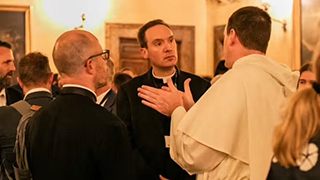
Reverend Joseph R. Laracy, S.T.D., at the Builders AI Forum in Rome, Italy.
The Reverend Joseph R. Laracy, S.T.D., associate professor and chair of Systematic Theology at Immaculate Conception Seminary School of Theology (ICSST), is currently spending a portion of his sabbatical as a visiting scholar at the University of Oxford, England.
“I’m very grateful to the Faculty and Rector-Dean of Immaculate Conception Seminary School of Theology, as well as the Provost and the University Research Council (URC) for the opportunity for this sabbatical,” Laracy says. Partly supported through a research grant from the URC, he is currently conducting his research at Blackfriars Hall, a permanent private hall of the University of Oxford.
“It is a privilege to be an academic visitor at Blackfriars Hall and the Faculty of Theology at Oxford University,” Laracy adds. “Oxford goes back to the eleventh century, and the Dominicans came here within five years of the approval of their order by the Pope in the thirteenth century.” Within this setting, shaped by centuries of theological and philosophical inquiry, Laracy has been invited to contribute to global conversations on technology and faith.
“While my principal purpose for the visit is research, the director of the Aquinas Institute at Oxford invited me to give a lecture,” Laracy says. On January 22, he delivered the address titled “Ontological, Anthropological, and Ethical Reflections on Artificial Intelligence in a Thomistic Key.”
In the lecture, Laracy framed his remarks as “a Thomistic retrieval of perennial metaphysical and moral insights for contemporary reflection on artificial intelligence.” Moving between classical sources and contemporary concerns, he drew on Thomas Aquinas and modern Neo-Thomist interlocutors such as the late Seton Hall Distinguished Professor of Physics, Father Stanley Jaki, OSB. In doing so, he guided the audience through a threefold line of inquiry: ontological questions concerning the nature of AI, anthropological questions regarding its relation to human intelligence and agency and ethical questions surrounding its design, use and governance.
“The lecture also situates these reflections within the horizon of Catholic Social Teaching,” Laracy adds, “and points to its resources for evaluating the societal implications of emerging AI technologies.”
This Oxford lecture builds on a series of international conversations, spanning questions of technology and faith, in which Laracy has been actively engaged. Prior to his arrival in England, he was closely involved in high-level discussions in both Rome and New York focused on the ethical development and use of AI.
In early November 2025, Laracy took part in the Builders AI Forum, hosted by the Collegium Maximum at the Pontifical Gregorian University in Rome, Italy. The forum brought together AI developers, investors, scholars and thought leaders from around the world. Across the gathering, conversations focused on how emerging AI technologies might be shaped in ways attentive to human values and moral responsibility.
Later that month, on November 15, 2025, Laracy continued this work in New York City at the annual Gold Mass and Lecture hosted by the Society of Catholic Scientists. The day began with the Gold Mass at the Church of Notre Dame, followed by a luncheon program at the Thomas Merton Institute. At the luncheon lecture, Laracy delivered a talk titled “Human Dignity and the Ethics of AI.” In his remarks, he addressed ethical questions raised by emerging AI technologies, with particular attention to how respect for human dignity can guide their development and use.
After arriving in the United Kingdom in January 2026, Laracy further extended these conversations within British academic and faith communities. On January 20, he participated in The AI Ethics & Faith Event held at Lambeth Palace in London, where leading theologians, scholars and AI practitioners gathered for interfaith dialogue on the ethical implications of emerging technologies.
Building on these discussions, the dialogue will continue in February, when Laracy is invited to address the ART-AI group at the University of Bath. His seminar is titled “From Human Dignity to Responsible AI: Bridging Ethics, Design, and Governance.” ART-AI is a Centre for Doctoral Training (CDT) funded by UK Research and Innovation (UKRI), the United Kingdom’s national body for directing public research and innovation funding, and focuses on the development of accountable, responsible and transparent artificial intelligence.
As he continues his sabbatical at Oxford, Laracy remains grounded in his vocation, balancing high-level scholarship with pastoral service. “During my time at Oxford, I’m also assisting with priestly ministry at Saints Gregory and Augustine Church,” he notes. He describes this engagement with the local community as a gratifying aspect of his time at Oxford, adding that “the pastor and parishioners have been very welcoming.”
Categories: Faith and Service, Nation and World, Research, Science and Technology