

Inside the Core: Students Explore Rumi and Augustine
Thursday, October 29, 2026
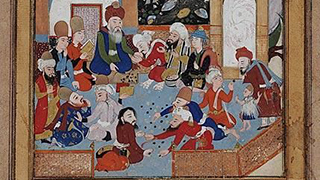
Rumi Distributing Sweetmeats, 16th century manuscript, Boston Museum of Fine Arts
Inside the Core many students in Core I are reading texts from the Islamic tradition (which includes poems by Rumi and specifically a poem entitled “The Guest House”) and they will also likely be reading this week or next week The Confessions of St. Augustine of Hippo. These texts, “The Guest House” and The Confessions speak to one another interestingly, particularly when looked at one just after the other.
Rumi, thirteenth century Persian poet and Sufi mystic, wrote this poem to celebrate being aware of and accepting ourselves, including what might be considered the negative aspects of our personalities and/or lives. Here is the poem in its entirety:
The Guest House
Jalaluddin Rumi
Translated by Coleman Barks
This being human is a guest house.
Every morning a new arrival.
A joy, a depression, a meanness,
some momentary awareness comes
as an unexpected visitor.
Welcome and entertain them all!
Even if they’re a crowd of sorrows,
who violently sweep your house
empty of its furniture,
still, treat each guest honorably.
He may be clearing you out
for some new delight.
The dark thought, the shame, the malice,
meet them at the door laughing,
and invite them in.
Be grateful for whoever comes,
because each has been sent
as a guide from beyond.
The poem is not saying we should celebrate our sins, but encourages readers to accept the varying thoughts and emotions that come “knocking on our door.” Inviting these “guests” in does not necessarily mean to indulge in them. Notice that some of the visitors to the guest house are feelings or moods – joy, depression, shame. Others are external to us but affect our moods – “a crowd of sorrows.” Some are actually what might be called sins – “the dark thought, the shame, the malice.” These last, of course, should not be embraced but, as seems the most likely way to read the poem, they should be looked at and understood, even though they should not be acted upon or indulged. However, overall, the poem suggests an acceptance of ourselves as we are in all our complexity and imperfections, with a sense that doing so can lead to positive change, with each ”guest” possibly “clearing you out/for some new delight.”

St. Augustine of Hippo
How does this poem relate to The Confessions of St. Augustine of Hippo? Augustine, who lived from 354 to 430, wrote his famous account of the first part of his life in order to convey his “confessions” to both God and to his audience. The word confession has two meanings in the Catholic Christian tradition of Augustine and his text reflects both of them – (1) testifying to one’s belief in God (as in the sense used in the term “confessor” for someone willing to die for a belief, even if they do not become an actual martyr) and (2) acknowledging one’s sins, as in the sacrament of reconciliation or even simply telling one’s sins to God in a spirit of repentance.
Though, contrastingly, the Rumi poem does not carry the list of visitors to the house of the self to a point of repentance, it advocates an honest and complete acknowledgement of who one is, with all thoughts and feelings explored, even if some might later be rejected or moved beyond. Augustine’s Confessions takes us through a similar (and more developed) journey of the self, as he examines his earliest smiles and infant selfishness to his struggles with lust and pride as an adult. Here is a text from a person who knows himself and truthfully exhibits all his frailties and sins to God, himself and the world.
This kind of honesty, advocated in the poem and expressed by Augustine, is the link between the two readings. Augustine goes farther than the poem in that he takes his confession of his sins and weaknesses to the point of his conversion from them and beyond. Having faced all his emotions (grief, love, lust, pride, etc.), he renounces those that he finds spiritually harmful and, most importantly, repents of those actions that are sinful, as told in Augustine’s movingly described encounter with God and His grace, told in the account of his conversion in Book VIII. Sometimes Augustine confesses actual sins (as when he and his friends steal the pears in his youth or when he lies to his mother about leaving Africa for Italy). Sometimes he simply confesses his human emotions – for example, his intense sorrow at separating from his partner of many years and the mother of his child or his enormous grief after the death of his mother, Monica. Most of all, Augustine’s Confessions express his profound transformation from the classic sinner (who famously prayed, “Give me chastity but not yet”) to the converted saint, who prayed the beautiful and powerful prayer, “Late have I loved Thee, Oh Beauty, so ancient and so new!”
These texts happen to come right next to each other in the Core I syllabus. Not everyone teaches Rumi’s poetry (as it is one of several possible selections from the Islamic texts from which faculty can choose) and not everyone teaches Augustine (as faculty may choose to teach Augustine or Dante or both). Many do, however, teach Augustine and Dante, as well as Rumi. As we see, the visitors to the “guest house” in Rumi’s poem are explored in great depth and detail in Augustine’s classic work.
St. John Henry Newman, British convert to Catholicism and eventually a Cardinal, wrote in his Sermon 9:
We have each the same secret, and we keep it to ourselves, and we fear that, as a cause of estrangement, which really would be a bond of union. We do not probe the wounds of our nature thoroughly; we do not lay the foundation of our religious profession in the ground of our inner man; we make clean the outside of things; we are amiable and friendly to each other in words and deeds, but our love is not enlarged, our bowels of affection are straitened, and we fear to let the intercourse begin at the root; and, in consequence, our religion, viewed as a social system, is hollow. The presence of Christ is not in it.
Augustine is embodying in his text what Newman is advocating in his sermon and Rumi’s poem suggests the first form of this honesty in being truthful with oneself.
Categories: Education, Faith and Service