

Inside the Core: Core I Classes Read Genesis, Exodus and Ruth
Friday, October 2, 2026
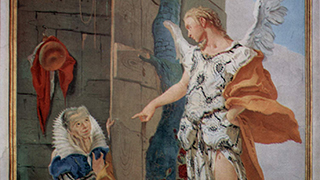
The Appearance of the Angel before Sarah, Tiepoli, circa 1727
Inside the Core, most Core I students are reading the Bible (Hebrew Scriptures/Old Testament) this week and next week, focusing on Genesis 12-25, Exodus 1- 20 (selected chapters) and the book of Ruth. There are countless interesting themes and topics to be drawn from these iconic sections of Scripture. One lens through which to glimpse them is through the women in the stories.
Genesis 12-25 tells the story of Abraham, forebear in faith to all Jews, Christians and Muslims in the world today. Called by the Lord while in Ur of the Chaldees (believed to be modern Iraq), Abram (called Abraham later by the Lord in one of the covenants made with him) traveled through Haran (northern Syria) to Canaan, the land promised to him and his ancestors. His wife Sarai, later called by the Lord “Sarah” meaning “Princess,” is an interesting example of strength, a strong will and developing faith. Though the Lord promised her and Abraham a child, Sarah perhaps grows tired of waiting and gives her maid, Hagar, to Abraham to bear a child in her name (an accepted practice of the time). However, when Hagar conceives, her apparent disdain of Sarah leads to conflict between the two women. Hagar flees from Sarah, but an angel finds her and comforts her and tells her to return, promising the Lord’s blessings on her child, Ishmael.
When Abraham is visited by three angelic messengers (or the Lord with two angels), he is told by them that at the same time next year, Sarah will have a son. She overhears this promise and laughs, “Shall I have pleasure being old?” When Abraham is asked by the Lord, “Why did Sarah laugh?” she replies, “I did not laugh.” Gently, the Lord says, “No but you did laugh.” Despite her somewhat understandable wavering in faith (she is quite elderly, past child-bearing age), the Lord keeps His promise to her and to Abraham and she bears Isaac, the longed-for son. Despite this blessing, Sarah again gets in conflict with Hagar, over some perception of rivalry between the two sons, the slave’s son Ishmael and Sarah’s Isaac. She demands from Abraham that Hagar leave with her son. Again, the Lord speaks to the exiled Hagar, comforting her and promising blessings on her son though the covenant will be with Isaac. The Lord’s dealings with the two women show the Lord’s sensitivity to both their situations – the long -time barren wife, the mistreated slave with faith in each of them growing despite their imperfections. As one student commented, Sarah is known to be beautiful (as mentioned several times), but her outward beauty is not always matched internally, with her infertility perhaps a sign of a lack of bearing fruit in other ways. However, as with Abraham, Sarah’s faith grows,and she also receives the promise of the Lord through her son Isaac and the covenant given to him and his descendants. Hagar too is not forgotten as the Lord reaches out to her with comfort and sustenance.
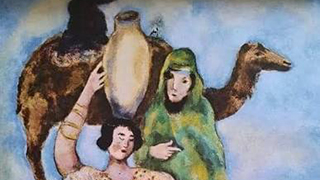
Rebecca (Rebekah) and Abraham's Servant, Marc Chagall, 1931
The story of Rebekah, who is chosen to marry Isaac, is also in this part of Genesis and though her part in the story is relatively brief in these early chapters, it is significant. After the death of Sarah, Abraham sends his servant back to his relatives to seek a wife for Isaac. Arriving at the well near this location, the servant prays that the young woman he asks for water and who offers also to draw for his camels, would be the one chosen for Isaac. Soon after the prayer, Rebekah appears and offers not only to give water to the man but for the camels as he had asked as the sign from the Lord. Inviting him back to the house of her father, Bethuel (and indeed he is one of the relatives of Abraham), it becomes clear that Rebekah has been chosen by the Lord for Isaac. It is a time of arranged marriages, so their not having met would not be that unusual. However, two things stand out about Rebekah, besides her physical beauty, which is also noted, as was Sarah’s. In her case, however, her inner beauty is also evidenced by her generosity in drawing for so many animals. It would have been a fair bit of work and effort to do what she so generously did. And when asked if she is willing to go right away with the servant to her new life with Isaac or to stay for 10 more days with her family, she chooses to go, a sign of great faith (in the sign given by the Lord, perhaps also some excitement for a new life). She is brave and trusting and she goes and we are told she was a comfort to Isaac after the death of his mother.
Finally, Ruth is the story of a Moabite woman, married to a man of Israel, who dies in Moab Her husband, his brother, father and mother, Naomi, had all come to Moab during a famine in Israel. All three men died, leaving Naomi with her two daughters-in-law, Ruth and Orpah. Hearing that the famine had ceased, Naomi plans to leave, but Ruth insists on accompanying her, over her mother-in-law’s encouraging both young women to stay and make a new life in Moab, their home. But, like Rebekah, Ruth chooses faithfully and bravely to accompany her mother-in-law to a new home, the land of Israel:
‘Do not press me to leave you
or to turn back from following you!
Where you go, I will go;
where you lodge, I will lodge;
your people shall be my people,
and your God my God.
Where you die, I will die—
there will I be buried.
May the Lord do thus and so to me,
and more as well,
if even death parts me from you!’
(Ruth 1:16-17)
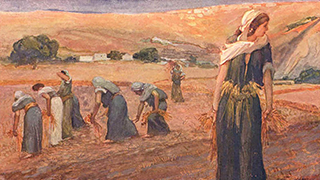
Ruth Gleaning in the Fields of Boaz.
A foreigner now in the land of Israel, with her home country, Moab, being a traditional enemy of Israel, she is befriended and eventually married by Boaz, a kinsman of Naomi who admires her devotion and kindness to her mother-in-law. As she works in his fields, he commands his servants to protect her, offering her grain to take home for herself and her mother-in-law. The story illustrates the ancient biblical injunction to be hospitable to strangers, a command illustrated in Abraham’s welcome of the angels at Mamre and elsewhere in the Hebrew Scriptures/Old Testament and continuing to the New Testament teachings of Jesus (Matthew 25: “I was a stranger and you welcomed me”) and the commands to “show hospitality to strangers” (Romans 12:13 and Hebrews 13:2). It also illustrates deep female friendship and devotion between Naomi and Ruth, as well as some initiative (as one faculty member recently pointed out) when Ruth goes to the threshing floor and makes a delicate invitation to Boaz on the threshing floor, showing her interest in him and leading to their marriage. The story culminates with the birth of Obed, born to Ruth and Boaz, with the joyful grandmother Naomi becoming his nurse.
These women are just a few of those whose stories are told in the Scriptures. Each of them illustrates the importance of faith, the independence and strength of women even in times when their role was very proscribed and their high dignity as daughters of the Lord and partakers of the covenant.
Categories: Education, Faith and Service