
TOAST: An Occupational Therapy Professor’s Initiative to Combat Student Burnout
Thursday, November 12, 2026
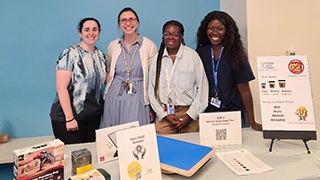
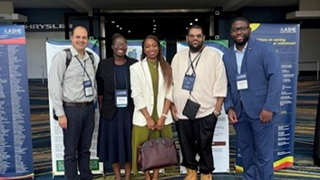
TOAST's interdisciplinary team includes Jamie Stillwell, Christina Barnes, LaMar Bolden and Ellen James (not pictured: Jayne Duncan)
Healthcare professionals and graduate students face an increased risk of experiencing burnout, a syndrome now classified by the World Health Organization as an occupational phenomenon resulting from chronic workplace stress. Burnout is characterized by feelings of exhaustion, mental distancing or cynicism and reduced cognitive efficacy. After observing increasing signs of burnout among her students, Seton Hall Assistant Professor of Occupational Therapy LaMar Bolden, D.P.S., OTR, CNS, decided to take action. On September 15, she launched TOAST, an initiative designed to promote the mental and emotional well-being of students in the School of Health and Medical Sciences (SHMS) by equipping them with practical strategies they can carry from the classroom to the clinic and beyond.
The name “TOAST” is both an acronym and a metaphor. It stands for Time Out And Self-Care Tools, serving as a catchy reminder for awareness and action to counter the metaphor for how one feels when they are on the verge of burnout, Bolden explained.
“In an effort to support [my students’] mental wellness, I began asking them, ‘How’s your toast?’ as a way for us to communicate and check in,” she said. “It caught on, and students would self-report and discuss their level of ‘crispiness,’ or how close they felt to burning their ‘toast.’”
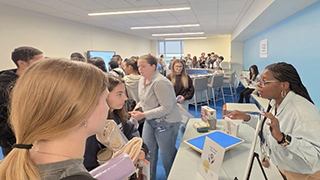
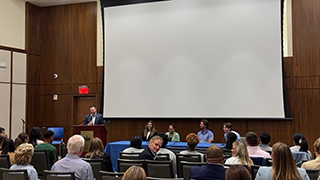
LaMar Bolden speaks with students at the IHS campus event.
Bolden started conversations with SHMS colleagues and professionals from Seton Hall’s Counseling and Psychological Services (CAPS) about supporting graduate students entering healthcare professions where burnout is a significant concern and the plan for TOAST was born. Bolden and her team — Christina Barnes, SLP-D, CCC-SLP, Jayne Duncan, Ph.D., Ellen James, Ed.D., OTR-L and Jamie Stillwell, Psy.D. — applied for and received an Idea Hall grant from the Office of the Provost to fund the core components of the program. These include online Canvas modules focused on burnout prevention, increased awareness of CAPS resources and in-person TOAST events at Seton Hall’s Interprofessional Health Sciences (IHS) campus where students can take an intentional time-out from their academic responsibilities and engage in a variety of self-care activities alongside their peers.
Another key component of the program is a physical self-service cart located in the Student Services room (Suite 1500, IHS). Funded through the grant, the cart offers students a selection of free self-care tools including stress balls, pocket journals with reflective writing prompts, mindful coloring books and colored pencil sets, sleep masks, resistance bands and sensory fidget toys. Students can stop by between classes, pick out any items that they find helpful and leave feedback through an online QR code form.
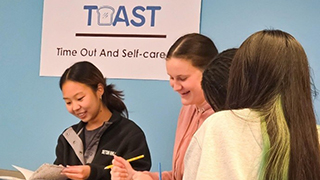
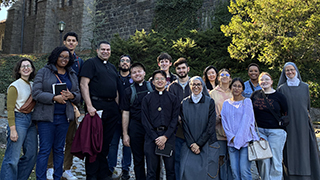
Health professions students learn how to manage stress at a TOAST event.
September's kickoff TOAST event was a success — more than 100 students from multiple SHMS programs attended, along with faculty representatives from Seton Hall's M.S. in Occupational Therapy and M.S. in Speech-Language Pathology programs and CAPS. Attendees received a self-care take-home bag, a slice of pizza and an entry into a raffle for larger wellness-related prizes. After learning about TOAST’s mission from Bolden, students were invited to complete the Burnout Assessment Tool for Students (BAT-S), an online rating tool developed in 2020 by researchers from Belgium and the Netherlands to measure students’ level of academic burnout across four symptom areas. Students discussed their results or their “crispiness” levels, with each other and were encouraged to reflect on any potential barriers to self-care in their current routines.
The second TOAST event, held on November 4, provided students with another opportunity to step away from their busy schedules and recharge. Students grabbed a snack, made their own paper fidget tools, participated in a simple yoga routine, decompressed in a calming sensory room and connected with friends before resuming their studies.
“The TOAST program allows students to connect through their shared experiences with stress, reminding us that we are not alone in dealing with it,” said M.S. in Occupational Therapy student Jason Piccolomini. “The event opened my eyes to different ways of managing burnout that I may not have considered on my own. I appreciate everyone involved in TOAST for making students feel seen and supported, and I plan to apply what I learned to better manage stress in my own life.”
Seton Hall takes pride in being a home for the mind, heart and spirit. TOAST builds upon this mission by supporting healthcare students in a new and holistic way, addressing a very real challenge within the field and creating a stigma-free space to prioritize mental, emotional and physical well-being.
“We believe that integrating habits that promote mental and emotional wellness early in professional identity formation will be valuable to our students now and in the future,” said Bolden.
Categories: Community Engagement, Health and Medicine