
Second Annual ‘Ethics and Values in the Era of AI’ Seminar Announced for October 24
Thursday, September 3, 2026
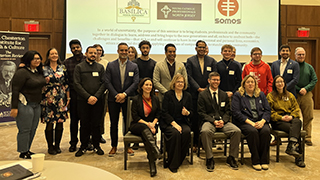
AI ethics seminar, January 2026
Artificial intelligence is rapidly transforming classrooms, financial decision-making and healthcare, making questions of human dignity, trust and responsible leadership more urgent — and more practical — than ever. On Saturday, October 24, 2026, the Center for Catholic Studies at Seton Hall University and the International Academy of Catholic Leaders will convene the second annual Ethics and Values in the Era of AI seminar, inviting participants into a timely, mission-centered conversation about how ethical judgment can guide the responsible use of AI across education, finance and healthcare.
This year’s free, one-day seminar, Ethics and Values in the Era of AI: Magnifica Humanitas and Our Shared Future, continues the Center for Catholic Studies’ broader Ethics and Values in the Era of AI initiative. Connecting Catholic intellectual and social thought with consequential choices across today’s institutions and professions, the initiative asks not only what AI can do, but how it can serve people, communities and the common good.
The subtitle Magnifica Humanitas and Our Shared Future draws on Pope Leo XIV’s encyclical Magnifica Humanitas, which focuses on safeguarding the human person in the time of artificial intelligence. The encyclical calls for discernment rooted in human dignity, responsibility and the common good — questions that will animate the October seminar.
Patrick Manning, Ph.D., director of the Center for Catholic Studies, said, “Pope Leo has offered the Church and the world timely guidance at this pivotal moment in human history. We look forward to gathering members of the university and the wider community on October 24 and unpacking this wisdom in a spirit of hope and dialogue.”
Through perspectives from education, finance and healthcare, participants will take up questions that now affect classrooms, boardrooms and care settings: How can educators use powerful tools without weakening judgment, relationships or the human work of teaching? How can financial innovation remain accountable to people and communities? How should healthcare leaders weigh the promise of AI against questions of trust, privacy, bias, accountability and the meaning of human care?
Confirmed Presenters
Education will feature a three-person panel spanning higher education, Catholic formation
and hands-on K–12 experience with AI. Sebastian Budinich, a doctoral candidate in
theological and social ethics at Fordham University who also teaches theology at Fordham
and Manhattan University, will bring a theological and humanistic lens to questions
of meaning, discernment and critical thinking, informed by experiments with AI in
his own classrooms. Chris Tyrrell will bring experience with AI implementation and formation in K–12 and classical-school
settings, connecting emerging tools to the day-to-day realities of school communities.
Douglas Minson brings firsthand experience overseeing and teaching elementary and middle-school
students using AI-enabled learning platforms in a Catholic educational setting. Together,
the panel will examine not simply whether schools can use AI, but how educators can
preserve judgment, relationships, critical thinking and whole-person formation as
these tools enter classrooms.
For finance, Rocco Papandrea, managing director and international wealth advisor with Merrill Lynch Wealth Management, brings more than 30 years of wealth-management experience advising individuals, institutions, business owners and nonprofits. He also serves as chair of the Audit Committee for SOMOS Community Care, giving him a perspective that crosses finance, governance and healthcare. His contribution will ground the finance conversation in fiduciary responsibility, trust and the practical challenge of using emerging technologies while keeping people and communities at the center of financial decision-making.
Additional presenters and contributors are being finalized and will be announced as they are confirmed.
Designed for conversation rather than passive listening, the seminar will pair presenter insights with facilitated table discussions and moderated Q&A. Participants will have space to test ideas, learn across fields and connect ethical reflection with the decisions they face in practice.
Lara Bersano, executive director of the International Academy of Catholic Leaders, said,
Artificial intelligence is rapidly becoming one of the most powerful forces shaping our world, but the measure of its progress must always be the flourishing of the human person. Guided by Catholic Social Doctrine and the vision of Magnifica Humanitas, we have a responsibility to ensure that AI serves humanity — protecting human dignity, advancing the common good and helping build a more just and humane future for all.
The October seminar builds on the January 2026 Ethics and Values in the Era of AI gathering at Seton Hall University, carrying forward participant interest in practical, case-based discussion of AI ethics and real-world applications.
The October 24 seminar is presented by the Center for Catholic Studies at Seton Hall University and the International Academy of Catholic Leaders. It is offered in partnership with the G.K. Chesterton Institute for Faith and Culture, the Joseph A. Unanue Latino Institute and Campus Ministry and in collaboration with Basilica Medical Management and SOMOS Community Care. Together, the collaborators bring Catholic, academic and professional perspectives to the seminar’s central questions.
The seminar welcomes Seton Hall students, faculty, staff and alumni, along with educators, academic leaders, finance and business professionals, healthcare professionals, Catholic leaders and community members. No technical background in AI is required.
Event Details and Registration
The free, one-day seminar will take place in the Chancellor’s Suite of the Bishop
Dougherty University Center. Check-in begins at 8:30 a.m.; the program runs from 9
a.m.—4 p.m. Eastern; and an optional Mass follows at 4:30 p.m. in the Chapel of the
Immaculate Conception.
Participants may attend in person at Seton Hall University. A limited virtual participation option is planned. Virtual participation is expected to provide remote access to selected portions of the program. Additional details will be shared with registered virtual participants before the seminar.
Registration is free, but space is limited and advance registration is required. Register for the October 24 seminar or view event details.
Categories: Community Engagement, Education, Faith and Service