
Seton Hall Hosts Two-Day Seminar on Ethics and Values in the Era of AI
Monday, February 9, 2026
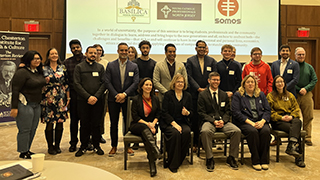
Seminar speakers, partners and organizers gather in Bethany Hall following the two-day Ethics and Values in the Era of AI seminar at Seton Hall University.
Seton Hall hosted a two-day seminar, Ethics and Values in the Era of AI, on January 30–31, 2026, convening students, educators, professionals and community partners for sustained dialogue on the ethical, social and economic implications of artificial intelligence.
Presented by the International Academy of Catholic Leaders in collaboration with the G. K. Chesterton Institute for Faith & Culture, the Center for Catholic Studies, Campus Ministry and the Joseph A. Unanue Latino Institute and in partnership with Somos Community Care, Basilica Medical Management and Young Catholic Professionals North Jersey—the gathering combined keynote presentations, panel discussions and facilitated table conversations grounded in Catholic social teaching and a commitment to human dignity.
Gloria Garafulich-Grabois, director of the G. K. Chesterton Institute for Faith & Culture, reflected on the significance of hosting the inaugural New Jersey seminar of the International Academy of Catholic Leaders. “It was a privilege for Seton Hall University to host the inaugural New Jersey seminar of the International Academy of Catholic Leaders, presented in collaboration with multiple university units and external partners,” she said. "Over the course of two days, the seminar addressed timely and important questions that are increasingly present in our professional and daily lives. The presentations and discussions invited us to critically assess and embrace Catholic ethics and values when engaging this new technology — recognizing its potential for great good, as well as the serious consequences when it is used without moral grounding."
Across both days, speakers emphasized that artificial intelligence is not ethically neutral and must be shaped by moral discernment, responsibility and concern for the common good. Dr. Shariff de los Santos, co-founder of Basilica Medical Management, underscored the urgency of values-based leadership amid rapid technological change. “In a world where technology evolves faster than ever, this seminar was a powerful reminder that progress without values is not true progress,” he said. "Artificial intelligence can become a great tool for humanity, but only if it is guided by principles such as truth, dignity, responsibility and respect for human life. As Catholic leaders, we are called not only to embrace innovation, but to ensure that innovation serves the common good and remains aligned with the moral teachings of the Church."
Friday’s programming focused on ethical foundations and leadership formation, while Saturday’s sessions expanded the conversation to workforce dynamics, economics and public life. Presentations and discussions addressed topics ranging from human dignity and moral agency to labor, democracy and the formation of leaders capable of navigating rapid technological change with wisdom and integrity.
Mario J. Paredes, Ph.D., president of the International Academy of Catholic Leaders, emphasized the formative role of Catholic higher education, highlighting the “key role of Catholic universities, such as Seton Hall, in exposing students to the social doctrine of the Church as an essential component of leadership in all areas of society.” He also noted that “artificial intelligence should be seen as a tool to develop human intelligence, human empathy and human decision-making.”
Reflecting on the seminar, Patrick R. Manning, Ph.D., director of the Center for Catholic Studies, noted the importance of collaboration. “The seminar was a beautiful event, born of the collaboration of numerous university and external partners,” he said. “The conversations that occurred over these two days about values and our human needs and capacities are badly needed as this new technology continues to impact our lives.”
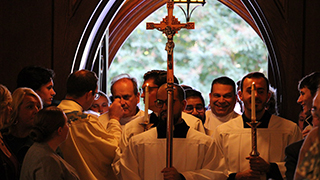
The seminar concluded with a Vigil Mass in the Chapel of the Immaculate Conception, underscoring the integration of intellectual inquiry, professional formation and spiritual reflection that defined the gathering.
For a complete list of presenters and sessions from the seminar, please click here.
For more information, please contact the Center for Catholic Studies at [email protected].
Categories: Education, Faith and Service, Science and Technology