
How One Lesson Sparked Research in Food and Sustainability
Friday, December 12, 2025
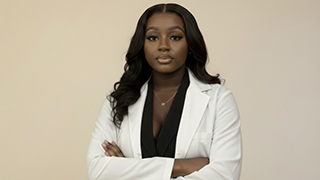
Judith Marfo, graduate candidate in the M.S. in Chemistry program.
Seven words that stayed with her long after she left the Ghana Armed Forces Military Hospital: “drugs are not what can cure diseases.”
During the COVID-19 pandemic, Judith Serwaa Marfo worked as a pharmacy and research assistant in the Ghana Armed Forces. Fulfilling Ghana’s required year of national service, Marfo watched patients arrive with a new illness – and other sicknesses – that medicine alone could not solve.
Her supervising pharmacist repeated that phrase often; not as a criticism of medicine, but as a reminder that health begins with nutrition. Recalling his words, Marfo explained: “The proper cure is what we eat: the sauce, the food processes, production, agriculture. This interest sparked what I wanted to study next.”
That early lesson is what shaped the steppingstones of her graduate research at Seton Hall University, where Marfo is pursuing her M.S. in Chemistry and preparing for Ph.D. candidacy.
Her work, which explores how atmospheric cold plasmas can improve crop yields, recently earned her second place for at the Maiden Research Expo at the Graduate Students Association of Ghanaian Students (GRASAG-USA) Conference at Ohio University.
A Journey Built on Resilience

Marfo at the GRASAG-USA Conference in Ohio, where she received second place for her research. She first learned about the opportunity through another Ghanaian scientist and, with Seton Hall’s support, traveled to present her work for the first time.
Marfo grew up speaking British English, and standing in front of her first American classroom as a graduate teaching assistant wasn’t easy, Marfo reflected.
“When I spoke that the first day, I could see the confusion,” she recalled. “So I told them, ‘If you can excuse my accent, I promise you will enjoy this course and chemistry.’ And they did.”
Students regularly recommend her to their peers, with many writing that her class helped them enjoy a subject they once found intimidating. Today, Marfo serves as a graduate teaching fellow, leading undergraduate general chemistry labs and offering weekly tutorials to students who need extra support.
Teaching, she said, reminds her of the mentors who guided her in Ghana despite different equipment and resources: “I believe that I only came this far because I had good teachers back then.”
Finding a Research Home
Marfo’s path to Seton Hall began with curiosity and dozens of emails to chemistry professors across the United States. When she connected with Seton Hall, something clicked.
Her early conversations with faculty helped her envision a graduate program where she could grow as a researcher, with mentors and a community that would support her goals.
This belief deepened when she started to work more closely with Father Gerald Buonopane, Ph.D., and Jose Lopez, Ph.D., who now supervise her research on cold plasma applications in food and medicine.
Their work examines how controlled oxidative stress from cold plasma can stimulate higher plant yields. Using hydroponic systems and carefully controlled light exposure, Marfo grows basil plants in the department’s lab and treats a portion of them with cold plasma.
The results, she explained, are plants that grow larger, look healthier and produce higher essential-oil yields than untreated plants. “This is exciting because it opens the door to naturally grown, more potent sources of plant-based medicines and natural preservatives,” Marfo noted. “A step toward solutions that could benefit both human health and agricultural sustainability.”
At the Ohio conference, judges asked her to explain her research in three minutes to someone with no scientific background. “Before I could end my last sentence, the judges started clapping. That was when I knew I had really made sense to them,” said Marfo.
A Future Rooted in Purpose
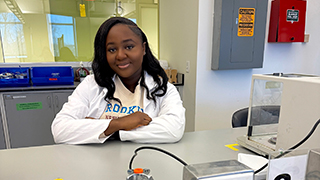
As a graduate teaching fellow, Marfo leads undergraduate chemistry laboratories from curriculum development to delivering lectures and ensuring lab safety.
Outside the lab, Marfo has become a resource for other Ghanaian students across the country, many of whom she first met online. She also served as director of social media and communications for the national Graduate Students Association (GRASAG-USA), helping connect students navigating similar academic and immigration landscapes.
Looking ahead, Marfo looks to gain industry experience in the United States — perhaps in pharmaceuticals or food science — and eventually bring that knowledge back home to where her interest in the field began.
“My hope is to learn how industry works here, whether it’s pharmaceutical or in the food industries, and then apply it back home.”
For more information about the M.S. in Chemistry or other graduate programs within the College of Arts and Sciences at Seton Hall University, please visit the Office of Graduate Affairs website.
Categories: Education, Research, Science and Technology