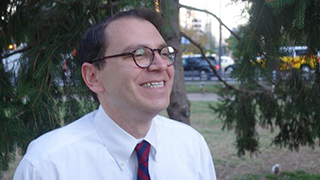

Jasmyne Emerson, Ph.D., Returns to Seton Hall
Tuesday, November 3, 2026
 For Jasmyne Emerson, Ph.D, returning to Seton Hall University as the Clare Boothe
Luce Assistant Professor of Physics represents more than a professional milestone.
It is a full-circle moment that connects her undergraduate experience with her commitment
to supporting the next generation of scientists and engineers.
After earning her Bachelor of Science in Physics from Seton Hall, Emerson pursued her Ph.D. in Materials Engineering at Purdue University, where she further developed her passion for scientific research. During her doctoral studies, she received a prestigious fellowship through the U.S. Department of Energy's Office of Nuclear Energy University Nuclear Leadership Program, which provided her with the opportunity to conduct research at Argonne National Laboratory's Advanced Photon Source. She was also elected as the Emerging Professional Member representative of the Nuclear Science User Facilities User Organization.
In August 2026, Emerson returned to her alma mater as the Clare Boothe Luce Assistant Professor of Physics, an appointment that carries special significance given her own experience as a scholarship recipient. As a first-generation college student, Emerson received the Clare Boothe Luce Mid-Career Scholarship for Outstanding Female Scientists during her undergraduate studies at Seton Hall. The scholarship provided financial assistance that allowed her to focus on research and prepare for graduate school.
"Returning to Seton Hall as a faculty member supported by the same program that helped make my academic career possible has been an incredibly rewarding, full-circle experience," Emerson shared. Now, she hopes to extend that same support and encouragement to students beginning their own journeys in science, technology, engineering and mathematics (STEM).
Making Physics Approachable Through Collaborative Learning
During her first semester back at Seton Hall, Emerson is teaching General Physics I, a course enrolling approximately 150 students, many of whom are pursuing degrees in biology, chemistry and other STEM disciplines. Recognizing that physics can sometimes appear intimidating, particularly to students whose primary academic interests lie outside the discipline, Emerson strives to make the subject engaging, accessible and relevant to their future careers.
Her teaching philosophy emphasizes collaborative learning, critical thinking and scientific communication. Rather than focusing exclusively on mastering equations and arriving at correct answers, Emerson encourages students to develop confidence in their ability to approach complex scientific problems.
One way she accomplishes this is through collaborative "group quizzes," during which students work in small groups to solve problems related to concepts discussed in lectures. These activities allow students to exchange perspectives, explain their reasoning and strengthen their understanding through peer-to-peer learning.
Emerson recently witnessed an especially memorable example of this approach during a group quiz focused on projectile motion. As students worked through the assignment, several began standing up and physically demonstrating projectile motion to help their classmates visualize the concepts being discussed.
"I loved seeing students take the initiative to find creative ways to communicate their understanding of physics," Emerson recalled.
For Emerson, moments like these demonstrate the value of an interactive classroom environment where students feel comfortable exploring scientific concepts together.
"Students are not simply working toward the correct answer; they are actively engaging with scientific concepts, communicating their ideas, and developing a deeper understanding of physics together."
Through these experiences, Emerson hopes students leave her classroom not only with a stronger foundation in physics but also with analytical, communication and problem-solving skills that will benefit them throughout their academic and professional careers.
Advancing Research in Nuclear Materials and Clean Energy
Beyond the classroom, Emerson is establishing a research program at Seton Hall focused on understanding how the structure and properties of materials influence their performance and reliability, particularly in energy-related applications.
Building upon her doctoral research in structural materials for nuclear energy, Emerson is eager to explore emerging opportunities in the field as New Jersey enters a new chapter in nuclear energy development following the lifting of its moratorium on new nuclear power plant construction. Her research seeks to better understand the relationships between how materials are processed, their internal structures and their ability to withstand demanding operating conditions.
In addition to nuclear materials, Emerson is expanding her work into other clean-energy technologies, including solid oxide fuel cells. One of her current research directions examines how the microstructure and mechanical properties of fuel cell components affect their long-term durability and reliability. She is also interested in using advanced characterization techniques, including synchrotron X-ray methods, to investigate how materials change during operation. By studying these relationships, Emerson hopes her research will contribute to the development of more efficient, reliable and sustainable energy technologies.
Equally important to her research goals is the involvement of Seton Hall students in meaningful scientific discovery. Emerson envisions a research environment where undergraduate and graduate students can gain hands-on laboratory experience, develop technical skills and learn how to communicate their findings through presentations and other scholarly opportunities. She is particularly passionate about creating an undergraduate-centered research program that welcomes students regardless of their previous research experience.
Through these opportunities, students can move beyond learning scientific concepts in the classroom and begin applying their knowledge to real-world challenges in materials science and energy technology.
Creating Opportunities for the Next Generation of Scientists
As Emerson looks toward the future of her career at Seton Hall, she remains committed to advancing the mission of the Clare Boothe Luce Program by encouraging women and students from historically underrepresented backgrounds to pursue opportunities in STEM.
Having experienced firsthand the impact that financial support, mentorship and access to research can have on a student's academic journey, she hopes to provide similar opportunities for others.
"Having personally experienced how transformative access to mentorship and research opportunities can be, I want to help provide those same opportunities to the next generation of scientists and engineers," Emerson explained.
Her long-term goals include expanding research opportunities for students, establishing collaborations within and beyond the University and strengthening Seton Hall's contributions to scientific innovation.
Through interdisciplinary partnerships and student-centered research initiatives, Emerson hopes to build a program that supports scientific advancement while preparing students for successful careers in science and engineering.
Ultimately, her vision extends beyond laboratory discoveries and academic achievements. She hopes to foster a learning environment where students feel encouraged to ask questions, embrace challenges and recognize their potential as scientists.
"I want to contribute to an environment where students feel supported, challenged, and empowered to pursue careers in science and engineering."
Exploring Opportunities in the College of Arts and Sciences
Emerson’s dedication to scientific discovery, innovative teaching and student mentorship reflects the broader mission of Seton Hall University’s College of Arts and Sciences to foster intellectual curiosity, academic excellence and meaningful professional development. By combining rigorous academic instruction with hands-on research opportunities, the College prepares students to think critically, collaborate effectively and apply their knowledge to challenges beyond the classroom. Through faculty members like Emerson, the College continues to cultivate an environment where students are encouraged to explore their potential, contribute to their communities and become leaders in their respective fields. Her return to Seton Hall serves as a testament to the lasting impact of a College of Arts and Sciences education and its commitment to shaping future generations of scholars, researchers and innovators.
Categories: Alumni