
From Honorable Mention to First Place: Ekta Dhotre on Writing, Inspiration and Finding Her Voice
Thursday, January 22, 2026
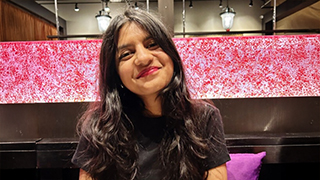 Each year, the Elizabeth Ann Seton Center for Women’s Studies at Seton Hall University invites high school students to reflect on the women who
have shaped their lives through its annual essay contest. For Ekta Dhotre, that invitation
became a multi-year journey — one that began with an Honorable Mention in 2022 and
culminated in a first-place win in 2024. Today, she’s a Seton Hall student herself,
pursuing a demanding academic path while still holding close the stories that inspired
her writing.
Each year, the Elizabeth Ann Seton Center for Women’s Studies at Seton Hall University invites high school students to reflect on the women who
have shaped their lives through its annual essay contest. For Ekta Dhotre, that invitation
became a multi-year journey — one that began with an Honorable Mention in 2022 and
culminated in a first-place win in 2024. Today, she’s a Seton Hall student herself,
pursuing a demanding academic path while still holding close the stories that inspired
her writing.
Ekta attended Parsippany High School, where she first learned about the Elizabeth Ann Seton Center for Women’s Studies essay contest through her English teacher. At the time, she had already developed a strong relationship with reading and writing, though she describes herself as “more of a reader than a writer.” Writing, for her, was always a challenge, but one she enjoyed because it allowed her to translate complex, emotional thoughts into something others could understand.
Over the course of high school, Ekta entered the contest three times; during her freshman, sophomore and junior years. Her most successful entries were deeply personal, grounded in relationships that had directly shaped who she is. For her first submission, which earned an Honorable Mention, Ekta wrote about her fifth-grade English teacher. At a young and formative time in her life, this teacher provided not only instruction but a sense of caring and community that Ekta hadn’t experienced in a classroom before. She describes the teacher’s influence as almost maternal, someone who taught her pivotal lessons about connection and belonging at a moment when those ideas were just beginning to take shape.
Her first-place essay in 2024 focused on a different kind of role model: Melinda Ernst, her supervisor in a volunteer EMT squad. As a junior member of the squad, Ekta trained under Ernst and quickly became inspired by her dedication. Ernst balanced multiple demanding roles: working as a special education teacher, holding a second part-time job and volunteering countless hours as an EMT. What stood out most to Ekta was not just how busy her supervisor was but also how fully committed she remained to every responsibility. While others might simply complete their required hours, Ernst routinely volunteered extra time, approaching the work with passion even during exhausting 20-hour days. For Ekta, witnessing that level of commitment was eye-opening. It showed her that it was possible to care deeply about multiple callings at once, and to do so with integrity and energy. Writing about Ernst became a way to honor that example.
Not every entry to the contest brought the same success. Ekta candidly reflects on the essay she wrote during her sophomore year, which did not place. That year, she chose to write about her grandmother, a woman she never truly knew due to a stroke that left her paralyzed for much of her later life. While Ekta admired her grandmother’s story and resilience, she realized in hindsight that the essay lacked a personal connection. The inspiration was secondhand, based on family stories rather than lived experience, and that distance made it difficult to write a fully reflective piece. Looking back, Ekta believes that authenticity made all the difference. When she focused on writing something she thought would appeal to judges, rather than something that genuinely moved her, the passion faded and so did the impact.
Her writing process itself is anything but formal. Ekta doesn’t outline or draft a structured plan. Instead, she relies on what she jokingly calls “word-vomiting,” pouring every thought and emotion onto the page in the moment inspiration strikes. Capturing those raw feelings immediately is essential for her; once the moment passes, she says, it’s nearly impossible to recreate the same voice. Editing comes later, once the emotions are safely on the page.
Winning first place in the contest proved to be a turning point. The recognition, especially from a university professor, boosted her confidence in a way she hadn’t expected. As a student largely immersed in STEM-focused academic spaces, Ekta rarely received affirmation for her writing. The validation reminded her that writing and literature weren’t just hobbies, but real strengths. That confidence translated into action. Inspired by her success, Ekta became involved in her high school newspaper at a time when it was struggling to survive. What began as a small commitment turned into a leadership role, allowing her to continue developing her voice and engage more deeply with the experiences of those around her.
Today, Ekta is a student at Seton Hall University, a choice influenced in part by the positive impressions she formed through the contest. After receiving her Honorable Mention, she reached out to Professor Mary Balkun, who coordinates the contest, for feedback and was struck by how open and encouraging she was. That sense of approachability and authenticity matched what Ekta later experienced when she visited campus, confirming that Seton Hall felt like the right fit.
Academically, Ekta is on an ambitious path. She is currently transitioning from psychology to a double major in biology and philosophy as part of the University’s seven-year B.S./M.D. program, with plans to pursue medical school. While she hasn’t settled on a specialty yet, she’s considering both psychiatry and obstetrics and gynecology, two very different fields that reflect her broad interests in both science and human experience. Ekta also remains grateful for the people who inspired her essays. Though she has unfortunately lost touch with her fifth-grade teacher, she hopes to reconnect someday. She remains in contact with her EMT supervisor, with whom she still shares a close bond.
When asked what advice she would give to students considering the contest, or to aspiring writers in general, Ekta doesn’t hesitate. Her message is simple: write what’s real. Even if it feels cliché, even if it feels insignificant, authenticity resonates. Human experiences of inspiration, mentorship, and change are universally relatable, she says, and sharing them matters more than winning a prize. Ultimately, Ekta views the Elizabeth Ann Seton Center’s essay contest as more than a competition. For her, it was an opportunity to pause, reflect and recognize the women who shaped her life and, in doing so, to better understand herself. Now, as a Seton Hall student, she sees the contest as a tradition she’s deeply thankful for, one that challenged her, inspired her and helped guide her to where she is today.
Categories: Arts and Culture, Education