
Seton Hall Students Take the Stage at the BIG EAST Symposium at Madison Square Garden
Tuesday, March 24, 2026
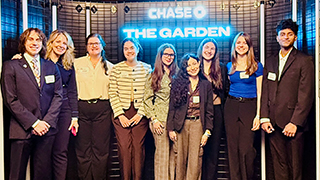
Student researchers, faculty mentors and administrators gather at Madison Square Garden during the 2026 BIG EAST Undergraduate Research Poster Symposium.
On Saturday, March 14, 2026, five undergraduate research teams from Seton Hall University stepped into one of the most iconic arenas in the world — Madison Square Garden — joining peers in the conference’s annual tradition of academic achievement: the BIG EAST Undergraduate Research Poster Symposium.
Hosted before the men’s basketball championship game tipped off, the annual event brings together undergraduate scholars from across the BIG EAST conference universities for a day of academic competition and collaboration.
The University’s five teams represented a range of disciplines across the sciences, humanities and social sciences.
Projects were evaluated by a committee on a range of criteria, including visual quality and clarity of content, effectiveness of the introduction, depth of results and discussion, presentation style and the presenters’ ability to respond to questions. Judges also assessed how well each team provided sufficient background, engaged the audience and demonstrated subject knowledge, according to the BIG EAST.
The University’s five projects represented a range of academic areas, selected through a competitive application process managed by the Office of the Provost. Faculty mentors worked closely with the selected students to refine their research narratives, with the Office of the Provost supporting logistics, coaching sessions and presentation strategy.
The Monday prior to the competition, students also gathered on campus for a full poster practice-through. In front of faculty, peers and staff who stopped by the Regent’s Suite, they practiced delivering their explanations and responding to questions.
“This experience reflects the kind of learning and practice that Seton Hall looks to focus on: an environment where students apply their knowledge in real-world settings and practice intentionally while being supported – and challenged – by our outstanding faculty,” said Interim Provost and Executive Vice President Erik Lillquist. “This approach directly echoes our strategic plan by expanding access to meaningful research opportunities and preparing students to contribute beyond the classroom.”
The team’s hard work paid off as teammate and senior Krish Reddy earned third place in the Health Sciences/Biomedical category for his research exploring a green tea–derived compound as a potential tool in combating drug-resistant pathogens.
Student Research Across Disciplines
Across disciplines, students presented research that addressed topics ranging from public health to literature.
Lianna Cruz and Maia Coyle: Reading the Messages of the Runway
Mentor: Jon Radwan, Ph.D.
Drawing on Langerian theory, Lianna Cruz – junior, Visual and Sound Media major – and Maia Coyle – junior, Communication major – presented their study of the unspoken language of the fashion runway. They examined how rhythm, pacing and body movement work together with clothing to shape what audiences take away from a New York Fashion Week show. Analyzing three runway collections — Coach, Off‑White and Thom Browne — they sought to demonstrate how movement can strengthen a designer’s message or shift the interpretation entirely. Their project offered a lens on fashion performance and how audiences make meaning from more than the clothes.
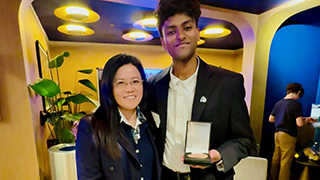
Krish Reddy stands with his award-winning research on antibiotic resistance with faculty mentor Tinchun Chu, Ph.D.
Krish Reddy: Targeting Drug‑Resistant Bacteria with a Green‑Tea Compound
Mentor: Tinchun Chu, Ph.D.
In his project, Reddy – senior in the B.S. Biology/Joint M.D. program – evaluated whether a lipid‑modified green‑tea compound (EC16) can counter bacteria linked to hospital‑acquired infections. By measuring inhibitory concentrations, cell‑count reductions, microscopy changes and possible synergy with standard antibiotics, he assessed EC16’s antimicrobial potential. Initial findings show strong activity against S. pneumoniae and E. faecalis, pointing to possible use in coatings or materials that reduce bacterial growth.
Gabriella Deguzman and Alyssa Housley: Understanding How Concussions Affect Students
Mentor: Meghan Caulfield, Ph.D.
Can quick, noninvasive measures detect lingering effects of concussions in college students? DeGuzman – senior Psychology Honors major and Pre-Med student –and Housley – senior Psychology Honors major – explored how concussions continue to shape thinking and behavior long after the initial injury — an issue that affects as many as one in five college‑age students. Their work pairs a decision‑making task with a noninvasive brain‑imaging tool to see whether students with concussion histories show differences in impulsivity and prefrontal cortex activity.
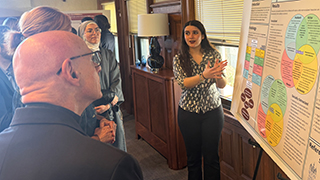
Students rehearsed their presentations during a campus-wide poster run-through (pictured: Gianna Vaynberg receiving feedback from faculty mentors and the Provost’s Office team).
Gianna Vaynberg: Nature in British Gothic Female Novels
Mentor: Mary Balkun, Ph.D.
Senior Vaynberg, who is pursuing a specialization in English, Elementary Education, Special Education, analyzed Gothic novels by women writers to understand how characters relate to nature. Her readings of Jane Eyre, Frankenstein, Wide Sargasso Sea and Rebecca reveal that oppressed characters often find refuge or alignment in natural settings, while their oppressors display ecophobia tied to social power. Her project reframed nature as a site of agency rather than terror, offering a richer understanding of how women writers reshaped the Gothic tradition.
Sean Coulson and Natalie Ruby: Finding Natural Ways to Keep Foods Fresh
Mentor: Reverend Gerald J. Buonopane, Ph.D.
What antioxidants are most effective at slowing down the fat‑oxidation process that affects food flavor, safety and shelf life? Using the TBARS assay, senior Chemistry majors Coulson and Ruby measured oxidation in foods with different moisture levels, comparing synthetic additives with natural alternatives like eugenol. Their early results show that both eugenol and a common preservative, BHT, perform well across varied conditions — information that could help food manufacturers balance shelf life with consumer interest in cleaner ingredient labels.
Categories: Research