
Ethics and Values in the Era of AI Connects Human Dignity With Everyday Decisions
Tuesday, November 3, 2026
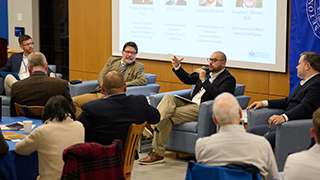
Education panelists explore AI’s role in education and human relationships.
Students, educators and professionals gathered at Seton Hall University on October 24 for the second annual “Ethics and Values in the Era of AI: Magnifica Humanitas and Our Shared Future.” The seminar examined how artificial intelligence can support education, finance and healthcare while preserving the human relationships and judgment essential to those fields.
The Center for Catholic Studies and the International Academy of Catholic Leaders presented the gathering in the Chancellor’s Suite of the Bishop Dougherty University Center, with an option to participate virtually. Pope Leo XIV’s encyclical Magnifica Humanitas provided the foundation for a day connecting Catholic social teaching with practical decisions in classrooms, workplaces and communities.
Patrick Manning, Ph.D., director of the Center for Catholic Studies, opened the seminar by connecting the Catholic intellectual tradition with the choices AI presents. “Our humanity and our way of life truly are at stake in how we decide to proceed with this technology, how we allow it to shape our lives,” he said.
Mario J. Paredes, president of the International Academy of Catholic Leaders, emphasized the human questions behind technological change. Reflecting on Magnifica Humanitas, he described it as “a document about what it means to be a human.”
Shariff De Los Santos, chief executive officer of Basilica Medical Management, connected the Academy’s leadership mission with Catholic social teaching. Ramon Tallaj Ureña, president of Basilica Medical Management, addressed the young people present, emphasizing that AI would accompany them through their studies and lives while human beings must remain involved in decisions.
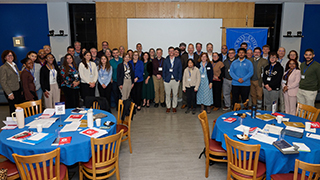
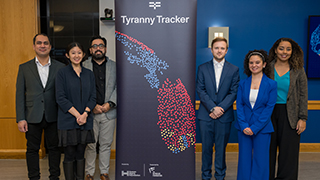
Participants gather for Ethics and Values in the Era of AI at Seton Hall University. Participants gather for Ethics and Values in the Era of AI at Seton Hall University.
The education panel, moderated by Manning, considered what students need to learn when AI can supply answers. Chris Tyrrell, founder of Classical Intelligence, emphasized the continuing importance of teachers and relationships. Speaking about AI’s role in education, he said, “But it will always need a partner, because ultimately, learning is relational.”
Sebastian Budinich, a doctoral candidate at Fordham University, brought a student’s concern about disappearing study groups into the conversation. Douglas C. Minson, chief academic officer of Classical Intelligence, drew on experience integrating AI into a Christian classical academy. Their contributions raised questions about learning alongside others, assessing understanding and choosing tools that serve education’s purpose.
Danielle Papandrea, managing director at Merrill Wealth Management, joined Gloria Garafulich-Grabois, director of the G.K. Chesterton Institute for Faith and Culture, for the session “Finance, AI and Human Dignity.”
Reflecting on Papandrea’s presentation, Michael J. Walsh, director of communications for the Diocese of Camden, wrote in feedback after the seminar, “Her confidence in utilizing AI without losing the human touch was a welcome thing to hear.”
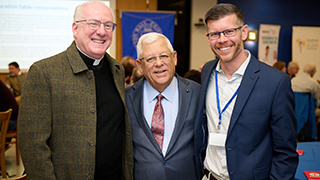
Monsignor Joseph R. Reilly, Sir Mario J. Paredes and Patrick Manning, Ph.D. at the October 24 AI seminar.
The healthcare discussion examined trust and the doctor-patient relationship. Elena Herrero of SOMOS Community Care presented an international survey concerning AI and that relationship. Diego Ponieman, M.D., M.P.H., a physician at the James J. Peters Department of Veterans Affairs Medical Center, drew on his clinical experience to discuss patients’ need to be heard.
Ponieman described how AI-assisted note-taking could help physicians focus on the person in front of them. He also emphasized the need for conversation to understand the concerns behind a patient’s decisions.
Facilitated table discussions and opportunities to bring questions back to speakers gave participants time to connect the presentations with their own experience. The format encouraged conversation across professions about where AI can help and where human involvement remains essential.
The gathering continued the Center’s AI initiative following its January 2026 seminar. Partners included the G.K. Chesterton Institute for Faith and Culture, the Joseph A. Unanue Latino Institute and Campus Ministry, with Basilica Medical Management and SOMOS Community Care collaborating. An optional Mass followed in the Chapel of the Immaculate Conception.
View the digital seminar program for the agenda and speaker information, and visit the Ethics and Values in the Era of AI webpage to learn more about the initiative.
Categories: Faith and Service