
Seton Hall’s Jacob Weger, Ph.D., Participates in Global Alliance for 'Laudato Si’ Convening in Rome
Thursday, April 30, 2026
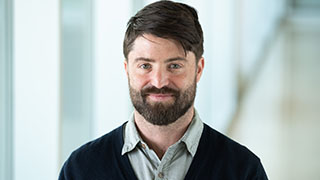
Jacob Weger, Ph.D.
On March 9–10, 2026, Jacob Weger, Ph.D., lecturer and director of the Environmental Studies Program at Seton Hall University, represented the University at a landmark international gathering in Rome: the inaugural convening of the Global Alliance for Laudato Si'. The conference brought together more than 100 researchers, educators and practitioners from across the globe, united by a shared commitment to advancing the vision of integral ecology inspired by Laudato Si'.
This historic convening was made possible through a collaboration between University of Notre Dame and the Vatican’s Laudato Si’ Center for Higher Education, establishing the Global Alliance as an international network focused on sustainability, ecological responsibility and interdisciplinary collaboration.
The two-day convening was designed not as a traditional academic conference, but as a collaborative effort to build a lasting, action-oriented alliance. Day one featured thematic sessions aimed at moving participants from diagnosis to vision to implementation, while day two focused on working groups tasked with developing concrete strategies and priorities for the future of the Alliance.
Weger participated as a panelist in the session titled “Transdisciplinary & Systems Models for Integral Ecology,” part of the “Enabling Collaboration” thematic block. This session explored how scholars, policymakers, practitioners and community leaders can work across disciplines and sectors to address complex socio-ecological challenges. Alongside fellow panelists Caroline Baillie, Johanna Herrera and Ramzy Kahhat, Weger contributed to a reflection-based dialogue that emphasized systems thinking, collaborative frameworks and the importance of aligning knowledge with action and accountability.
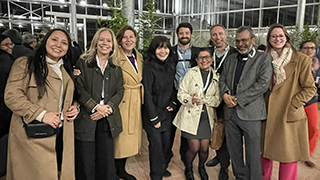
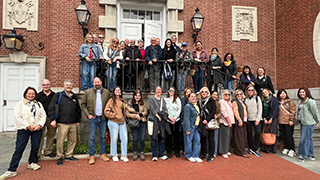
Weger with other attendees
Reflecting on the experience, Weger noted the “amazing energy and motivation” that came from being surrounded by colleagues who are deeply committed to forward-thinking, solution-oriented work. He also described his participation as an honor, emphasizing the value of contributing to a global collective of scholars and practitioners, including partners such as the University of Notre Dame, whose leadership helped bring the initiative to life.
Rather than focusing solely on completed research, the session encouraged participants to critically examine the assumptions shaping sustainability education and research today. Panelists were asked to identify gaps in current approaches, question dominant technocratic paradigms,and consider how the framework of integral ecology offers a more holistic and ethically grounded perspective. Conversations highlighted the importance of addressing power imbalances, fostering trust across institutions and rethinking traditional academic incentives that may hinder long-term, transformative collaboration.
A central theme throughout the session and the broader convening, was the need to move beyond fragmented efforts toward coordinated, durable action. Participants engaged in candid discussions about the barriers that often prevent innovative ideas from being implemented, including institutional constraints, limited funding structures and challenges in cross-sector communication. At the same time, the convening created space for forward-looking propositions, including new research questions, governance models and partnership strategies aimed at advancing integral ecology in meaningful ways.
The energy and collaboration extended beyond formal sessions. Attendees participated in working groups and informal discussions designed to build relationships and generate actionable outcomes. Organizers described the convening as a “historic moment” for the Global Alliance, laying a strong foundation for future initiatives and ongoing collaboration among institutions worldwide.
Weger’s participation in this global initiative reflects Seton Hall University’s broader commitment to academic engagement beyond the classroom. The College of Arts and Sciences continually seeks opportunities for faculty to engage in meaningful external experiences and global collaborations. By bringing these insights back to campus, faculty enrich academic programs, strengthen interdisciplinary learning and help cultivate students who are both knowledgeable and professionally prepared to address complex global challenges. Through involvement in initiatives like the Global Alliance for Laudato Si’, Seton Hall faculty continue to bridge scholarship and real-world impact, ensuring that students benefit from an education shaped by both academic rigor and global perspective.
For more information on the Global Alliance for Laudato Si’ and all things Environmental Studies at Seton Hall, contact [email protected].
Categories: Faith and Service, Nation and World