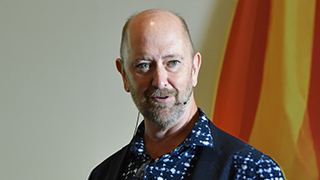

Disability Advocate Inspires Seton Hall Students to Engage in Systemic Reform
Thursday, November 5, 2026
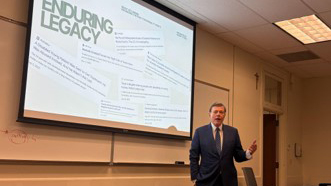 On Thursday, October 29, 2026, Seton Hall University welcomed Robert Stack, a USA Today best-selling author, disability rights advocate and founder, president and CEO of
Community Options, for a discussion examining the systemic challenges facing individuals
with intellectual and developmental disabilities. Drawing on themes from his book,
Silent No Longer, Stack explored critical concerns surrounding the disability services industry, including
the growing influence of private equity, institutional accountability and disparities
in access to quality care across the United States.
Stack's work challenges readers to confront longstanding concerns within the disability services industry and consider how financial incentives, institutional practices and unequal access to resources can affect the quality of care provided to individuals with disabilities.
A central focus of Silent No Longer is the increasing involvement of private equity firms in facilities serving individuals with intellectual and developmental disabilities. Stack examines how profit-driven business models can create conflicts between financial interests and the well-being of those receiving services. His work also raises concerns about practices that may allow facilities to present themselves as providing high-quality care despite underlying deficiencies.
Beyond institutional accountability, Stack explores disparities in disability services across the United States, including differences in funding, resources and access to appropriate support. These disparities raise important questions about equity and the extent to which individuals with disabilities and their families can obtain the services necessary to live with dignity and independence.
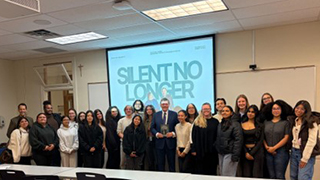 The issues explored in Silent No Longer have particular relevance to the field of social work, where professionals are called
upon to advocate for vulnerable populations, challenge systemic inequalities and promote
the dignity and worth of every individual. During his presentation, Stack outlined
nine calls to action aimed at advancing disability rights, including promoting integration
rather than segregation, ending institutionalization, eliminating state contracts
with for-profit providers, ensuring uniform Medicaid access across states and moving
away from segregated special schools. He also emphasized ending sheltered workshops
and subminimum wages, expanding community-based employment opportunities for adults
with intellectual and developmental disabilities, strengthening advocacy efforts and
leveraging artificial intelligence and robotics to promote greater inclusion. Together,
these recommendations challenged future practitioners to look beyond individual circumstances
and consider the broader policies, institutions and economic structures that shape
people's experiences.
According to the book's description, more than 8 million Americans have intellectual and developmental disabilities, with approximately 80 million family members connected to their lives and care. These figures underscore the far-reaching importance of conversations surrounding disability rights, service quality and meaningful reform.
For the Seton Hall community, Stack's work provides an opportunity to consider the relationship between professional responsibility, ethical leadership and social justice. It also reinforces the importance of listening to individuals with disabilities and their families when evaluating the systems intended to support them.
Through Silent No Longer, Stack calls for a renewed commitment to transparency, accountability and person-centered care, emphasizing that meaningful progress requires more than recognizing systemic problems. It requires a willingness to challenge practices that undermine dignity and to place the needs and rights of individuals with disabilities at the center of decision-making.
The event was sponsored by Seton Hall University's Department of Social Work and Public Administration, which offers a comprehensive range of academic programs designed to prepare students for leadership, advocacy and service in their communities. The department offers an undergraduate Bachelor of Social Work (B.S.W.) program, two graduate degrees, a Master of Social Work (M.S.W.) and a Master of Public Administration (M.P.A.), as well as two undergraduate minors in social work and nonprofit studies. Through these programs, the department emphasizes the connection between professional practice, public policy and systemic change, preparing students to address complex social challenges and advance more equitable and inclusive communities.
Categories: Education, Health and Medicine