
Seton Hall Chemistry Celebrates Three ACS Honors
Tuesday, November 10, 2026
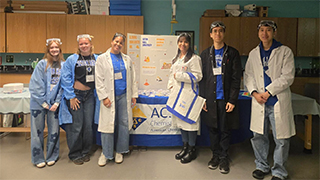
ACS Chem Club at the 2026 ChemEXPO at the LSC
Seton Hall University's College of Arts and Sciences is celebrating three significant achievements recognizing the University's commitment to scientific education, community outreach and academic excellence. The American Chemical Society (ACS) has recognized Seton Hall's Chapter and the University for their contributions to advancing chemistry education, supporting aspiring scientists and fostering meaningful engagement with local communities.
Among these accomplishments are the ACS Chapter’s 2nd place recognition for its work with K–12 students at the 2026 ChemEXPO at Liberty Science Center, the University's ACS Salutes to Excellence Award and the Honorable Mention ACS Student Communities Award for the 2025–26 academic year.
Together, these honors highlight the dedication of Seton Hall's chemistry students and faculty to extending scientific learning beyond the classroom and making chemistry accessible to individuals of all ages.
Inspiring the Next Generation of Scientists
One of the ACS Chapter’s recent achievements was earning 2nd place for its work in
educating K–12 students at the 2026 ACS ChemEXPO, held at Liberty Science Center.
The event provided an opportunity to engage younger learners through interactive scientific
demonstrations and educational activities designed to spark curiosity about chemistry.
This year’s theme was “Chemistry Under Construction”.
To demonstrate the theme, the chapter demonstrated two simple demonstrations in Oobleck mechanics and chemiluminescence. Oobleck, prepared by mixing cornstarch with water, is a non-Newtonian fluid and physically behaves both like a solid and a liquid. This occurs because the mixture’s viscosity changes depending on the forces exerted on it. Chemiluminescence was demonstrated by dissolving fluorescent dyes from highlighter ink into water. When this solution is shined with ultraviolet (UV) light, it glows!
The concepts behind these experiments are applicable to various construction applications; for instance, cement and concrete mixtures utilize the dual solid and liquid properties of Oobleck to pour, set and harden, laying the groundwork for constructing new buildings and bridges. Additionally, many fluorescent lightbulbs are coated in phosphor molecules that glow similarly to the highlighter ink when radiated with UV light, providing a versatile and relatively energy-efficient light source for industrial buildings.
The achievement reflects the chapters dedication to inspiring students in STEM while providing members with opportunities to strengthen their communication and scientific presentation skills. These experiences allow Seton Hall students to serve as mentors and ambassadors for the sciences, encouraging younger generations to explore their own interests in chemistry and related fields.
Joseph Badillo, Ph.D., who works closely with the Seton Hall ACS Chapter, expressed pride in the students' commitment and accomplishments.
"It's an honor to work alongside such talented and dedicated students!" said Badillo.
He was not alone. Kira Bringemeier, ACS President, with a B.S. in Biochemistry added:
"It was very inspiring to be able to work with the next generation of scientists. Every year it gets better and better.”
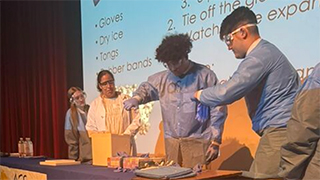
ACS at Don Bosco
Beyond the Liberty Science Center event, the ACS Chapter has continued its community outreach efforts with STEM outreach at Don Bosco Preparatory High School. These initiatives reflect the club’s ongoing commitment to connecting scientific knowledge with the broader community.
Recognizing Seton Hall's Longstanding Commitment to Chemistry
In addition to the ACS Chapter’s achievements, Seton Hall University received the
ACS Salutes to Excellence Award from the North Jersey Section of the American Chemical
Society (NJACS).
The award recognizes organizations and community partners whose outstanding service and accomplishments have positively impacted their communities or contributed to greater public awareness and appreciation of chemistry.
Seton Hall was selected in recognition of its longstanding partnership with NJACS, particularly its continued support of the ACS Project SEED program, which provides research opportunities for high school students from economically disadvantaged backgrounds.
For more than 20 years, Seton Hall has supported the program by providing a venue for student research poster sessions, allowing young scientists to present their work, develop professional skills and engage with members of the scientific community. Chemistry faculty have also served as dedicated mentors, helping high school students gain valuable research experience and encouraging their academic and professional development.
The University's contributions to NJACS extend beyond Project SEED. In 2025, Seton Hall hosted the Mid-Atlantic Regional Meeting, welcoming more than 650 scientists for a gathering celebrating the 100th anniversary of NJACS. The meeting featured scientific symposia, professional development opportunities and community-building events that brought together researchers, educators and professionals from across the region.
These longstanding efforts demonstrate Seton Hall's role in supporting scientific collaboration, expanding educational opportunities and strengthening connections between academic institutions and professional organizations.
The award was formally recognized at the NJACS Annual Awards and Recognition Dinner on May 28, where Badillo, 2026 NJACS Chair Elect, accepted the Salutes to Excellence Award on behalf of Seton Hall University.
Chemistry Club Earns National Recognition
Further highlighting the Chapter’s accomplishments, the American Chemical Society
awarded Seton Hall an Honorable Mention ACS Student Communities Award for the 2025–26
academic year.
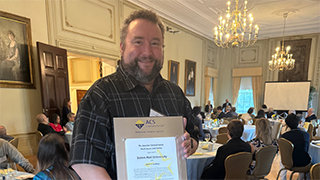
Badillo accepts the Salute to Excellence award on behalf of Seton Hall from the North Jersey ACS (NJACS)
The recognition celebrates the club's contributions to student engagement, chemistry-related programming and community outreach. It also acknowledges the dedication of student leaders who work to create meaningful opportunities for their peers while promoting enthusiasm for the chemical sciences.
Through educational events, outreach initiatives and collaborative experiences, the Chemistry Club has established an environment where students can develop their scientific interests, build leadership skills and contribute to their surrounding communities.
Receiving national recognition from ACS represents a significant accomplishment for the organization and reflects the collective efforts of its student members, officers and faculty mentors.
"It takes a tremendous amount of work to be recognized by ACS National for these awards, I'm so proud of our ACS leadership!" said Badillo.
The Honorable Mention distinction recognizes the club's accomplishments throughout the academic year and provides momentum for continued programming and engagement during 2026–27.
Advancing the Mission of the College of Arts and Sciences
These three recognitions underscore the importance of combining academic excellence
with experiential learning, mentorship and service. Through the Chapter’s outreach
initiatives and Seton Hall's longstanding partnerships with professional scientific
organizations, students are encouraged to apply their education in ways that extend
beyond traditional classroom experiences.
Cosimo Antonacci, Ph.D., emphasized the dedication of the students and their commitment to sharing their passion for science with the broader community.
"We are lucky to have such dedicated students who have a genuine passion for Chemistry and science. That passion extends beyond our 'Hall's, manifested in their servant leadership and outreach," said Antonacci.
Within the College of Arts and Sciences, opportunities such as these reflect a commitment to developing knowledgeable, compassionate and socially responsible leaders who use their education to make meaningful contributions to society. By participating in scientific research, community engagement and professional development, students gain valuable experiences that prepare them for careers in chemistry, healthcare, education, research and other STEM-related fields.
As Seton Hall continues to strengthen its presence within the scientific community, the accomplishments of the Seton Hall ACS chapter and related faculty demonstrate the lasting impact of collaboration, mentorship and service. These honors not only celebrate the University's achievements but also reinforce its commitment to inspiring future generations of scientists and advancing scientific discovery for the benefit of others.
These accomplishments further reflect the mission of Seton Hall University's College of Arts and Sciences to foster academic excellence, intellectual curiosity and servant leadership through meaningful educational experiences. By encouraging students to engage in scientific discovery, mentorship and community outreach, the College continues to cultivate future leaders who are committed to using their knowledge and talents to positively impact the world around them.
For more information about the Chemistry Club, its achievements or opportunities within the Department of Chemistry and Biochemistry, follow them on Instagram (@SHU_ACS) or contact Joseph Badillo, associate professor and director of Graduate Studies; Cosimo Antonacci, laboratory director and lecturer; or Nicholas Snow, Ph.D., department chair and founding endowed professor of Chemistry and Biochemistry.
Categories: Community Engagement, Research, Science and Technology