
Seton Hall Faculty Shine in October Media Across the Globe
Friday, November 6, 2026
 Throughout October 2026, Seton Hall University faculty members maintained a strong
presence across national and international media, delivering expert commentary on
healthcare liability, global energy geopolitics, media history, digital ethics, political
dynamics and more. Scholars offered critical insights to leading news outlets across
the globe, including Time, Newsweek, Politico, The New Yorker and Vanity Fair, among other local, national and international outlets.
The month opened with major contributions in health sciences, digital communications and state politics. In The Independent, biology professor Jessica Cottrell shared findings from a recent Seton Hall study on the musculoskeletal risks of vaping, revealing that flavored e-cigarette vapor disrupts cellular regeneration and impairs bone healing. Meanwhile, communications scholar Ruth Tsuria spoke to OK! News regarding synthetic media and deepfakes, warning that unchecked AI-generated misinformation threatens democratic discourse by eroding the public’s shared baseline of reality. On the political front, Matthew Hale offered analysis for NJ.com, explaining how national political alignment complicates state GOP efforts to win over moderate suburban voters in New Jersey.
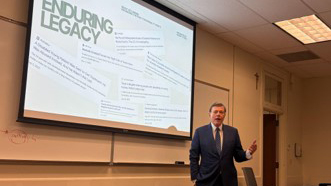
As the month progressed, faculty expertise included media history and high-stakes law. In an exclusive excerpt for Vanity Fair from his book The People’s Paper: The Rise and Fall of the New York Daily News, media historian Matthew Pressman explored the New York Daily News’ ill-fated attempt to pivot upscale, shedding light on the strategic perils tabloids face when shifting target audiences. Later in the month, Pressman also joined NY1 Spectrum News to discuss how the decline of classic tabloid journalism damages local civic engagement and erodes public trust.
Health law and regulatory frameworks also took center stage during the month of October. Writing for Time, Seton Hall Law professor Anjali Deshmukh examined the rapid expansion of compounding pharmacies producing GLP-1 weight-loss alternatives, emphasizing that commercial scale-up creates significant patient safety and regulatory gaps. In Newsweek and The Economic Times, Margarita Balmaceda provided energy political economy analysis on Russian diesel deals, warning that lifting sanctions throws an economic lifeline to Moscow and creates global policy inconsistencies with key international partners. On FOX News, law enforcement executive director Kishon Hickman discussed executive branch bounds, noting that judicial skepticism toward administrative overreach ensures federal agencies remain strictly accountable to statutory limits.
Mid-to-late October brought deep policy analyses across corporate, legal and educational spheres. In Gothamist, Hale outlined strategies for Democrats running in conservative New Jersey districts, emphasizing that local pragmatism and tax relief can bridge partisan divides. In Houston Chronicle, Seton Hall Law professor Jacob Elberg analyzed healthcare fraud proceedings, explaining how legal standards separate pure monetary non-compliance from direct evidence of patient harm. In The New Yorker, David Backer advocated for educational reform that democratizes school governance and prioritizes equitable public education over privatization, while Yanzhong Huang discussed escalating U.S.–China trade restrictions in Politico and MSN, highlighting how regulations on biotech and technology shape global supply chain continuity.
The month concluded with high-impact commentary on public policy, fan sentiment, labor protections and medical liability. For The New Republic, Hale detailed how federal legislative spending shifts under the One Big Beautiful Bill Act create severe budget trade-offs for state and local governance. Sports Business Journal featured findings from the Seton Hall Sports Poll, revealing that a majority of Major League Baseball fans support a salary cap ahead of CBA negotiations while remaining divided on labor accountability.
Closing out the month, Seton Hall Law professor Doron Dorfman analyzed how the unpredictable nature of Long Covid challenges ADA workplace protections in Mother Jones, leaving chronically ill workers vulnerable. Meanwhile, law professor Bryan Sheppard also touched on healthcare law in Mother Jones, highlighting how the "malpractice trap" clinicians face when integrating artificial intelligence into medical diagnostic workflows, underscoring how legacy liability frameworks fail to assign fault between human practitioners and automated systems.
Featured Media
- Economic Times, “‘Russian diesel won’t help US, it shows double standards on India’: Margarita M. Balmaceda, Professor at Seton Hall University”
- FOX News, “You don’t secure a search warrant off of a ‘witch hunt,’ Josh Ritter says”
- Gothamist, “For a Democrat in a traditionally red NJ district, how to woo Republican voters”
- Houston Chronicle, “Houston transplant surgeon case may be difficult for prosecutors as judge limits medical care evidence”
- The Independent, “Using flavored vapes could have a bigger impact on your health than previously known”
- Medscape, “Sued If You Do, Sued If You Don’t: The AI Malpractice Trap”
- Mother Jones, “Long Covid Disabled Millions of Workers. Then Came Trump 2.0.”
- Newsweek, “Trump Says Ukraine Needs New Leader Amid Dispute Over Russia Diesel Deal”
- The New Republic, “Here’s What’s Missing From the Affordability Discussion”
- The New Yorker, “Does the D.S.A. Have a Vision for Public Schools in New York?”
- NJ.com, “Donald Trump screwed N.J. Republicans in 2025. Looks like he’s doing it again.”
- OK! News, “Pope Leo Says AI Fears Aren't 'Fake News' and Rejects Donald Trump Characterization of Safety Concerns as a 'Hoax': 'This Is a Problem”
- Politico, “Biotech investment is the new front in the US.-China trade fight”
- Spectrum News NY1, “What the rise and fall of a legendary newspaper says about the media crisis today | You Decide”
- Sports Business Journal, “New SBJ/Seton Hall poll finds that majority of MLB fans support a salary cap”
- Time, “Compounding Pharmacies for Weight-Loss Drugs Are Booming. Should You Trust Them?”
- Vanity Fair, “Inside the Failed Daily News Tonight Experiment: 'Damn It, It Didn’t Work'”
Categories: Nation and World