
Occupational Therapy Students Bring Disaster Preparedness Training to Seniors
Wednesday, July 1, 2026
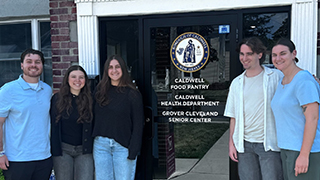
Left to right: Occupational therapy students Sebastian Graziano, Makenna Fabrazzo, Julia Dimino, Aidan Connolly and Alyssa Gesslein educated older adults on disaster preparedness at the Caldwell Community Center.
Seton Hall’s M.S. in Occupational Therapy (M.S.O.T.) program is making an impact beyond the classroom through an innovative, community-based disaster preparedness initiative. Designed to support one of the most at-risk populations, the program equips older adults with practical tools and knowledge to safely navigate emergencies ranging from extreme weather events to prolonged power outages.
Throughout the spring and summer semesters, 60 first-year occupational therapy students participated in this experiential learning model, bringing disaster preparedness education to close to 200 older adults in the area. Eleven student teams, trained by Meryl Picard, Ph.D., M.S.W., OTR, assistant professor in the Department of Occupational Therapy, delivered interactive sessions at senior centers across Belleville, Bloomfield, Caldwell, Hillside, Maplewood, Mine Hill, Montclair, Orange, Rockaway, Warren and West Orange.
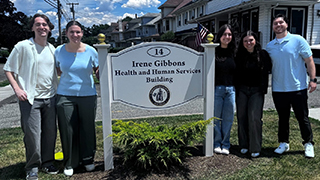
Occupational therapy students partnered with senior centers in 11 New Jersey communities to help nearly 200 older adults prepare for emergencies.
“Major weather-related disasters are increasing across the United States and globally, including flooding, tornadoes, wildfires, earthquakes and extreme heat,” said Picard. “Older adults, people with disabilities, children, people with chronic physical or mental health conditions and those living in under-resourced communities are especially vulnerable.”
Each session focused on empowering older adults to take proactive steps toward emergency readiness. Participants learned how to assemble emergency “go bags,” organize essential documentation, develop communication plans with loved ones and implement strategies to remain safe during shelter-in-place or evacuation scenarios.
The initiative has personal roots for Picard. She started thinking about disaster preparedness after her sister and brother-in-law lost half their home during Hurricane Irma in 2017. She’s since integrated disaster preparedness into her course on wellness and health promotion.
“Our goal is to equip every M.S.O.T. student in our program with this knowledge so they can, in turn, provide it to every individual and group they serve in future clinical practice,” she said.
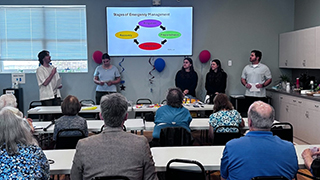
Occupational therapy students gained hands-on experience in health promotion, public speaking and community education while leading disaster preparedness presentations.
Attendees received student assistance to complete preparedness checklists to address their needs, along with refrigerator magnets outlining key safety steps, and survival whistles.
Several municipalities complemented the presentation by involving local Offices of Emergency Management and township officials, who addressed town-specific concerns and questions.
Feedback from participants consistently highlighted the professionalism, knowledge and compassion demonstrated by Seton Hall students.
“The Disaster Preparedness presentation at the West Orange Public Library was the highlight of my summer semester. I learned that people in the community want help and want to do better at preparing themselves in the case of a disaster,” said M.S.O.T. student Kaylen Glover. “They are curious and open-minded to any help they can get. This made presenting so easy and allowed for a great discussion full of laughter, stories, and a greater understanding for disaster preparedness."
Beyond its immediate community impact, the initiative provided students with hands-on experience in program development, health promotion, public speaking, co-leadership and community education — skills essential for future clinical practice.
It also strengthened partnerships between Seton Hall and neighboring communities, reinforcing the university’s commitment to service and experiential learning. This initiative underscores the vital role occupational therapy plays in promoting safety, independence and resilience, particularly in the face of unexpected events.
Special recognition is extended to Yolanda Sheffield Williams, the department secretary for occupational therapy, and M.S.O.T. student Lauren Quinn for their coordination and planning in establishing these community partnerships.
Categories: Health and Medicine