
St. Paul, Women and the Practice of Hospitality
Tuesday, July 21, 2026
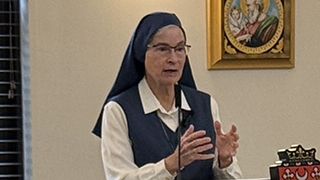
Sister Anne Joan Flanagan speaking at ICSST.
Immaculate Conception Seminary School of Theology (ICSST) at Seton Hall University welcomed Sister Anne Joan Flanagan, FSP, on May 2 for a presentation on “Welcoming the Word: St. Paul, Women, and the Practice of Hospitality.”
She framed her talk with these words:
When we look at what Paul did and wrote about collaboration, we find a variety of terms. He uses [words] like ‘collaborate,’ ‘cooperate,’ ‘communion,’ ‘sharing,’ ‘participation.’ But they all begin in an encounter with Christ and His Word. And that hospitality to the Word turns us into a place of welcome.
A member of the Daughters of St. Paul, Sister Anne is a New Orleans writer, inspirational speaker and talented singer. Her talk at ICSST was part of a day of recollection that included morning Mass with a homily by Father Dominic Ciriaco, D.Min., director of ICSST’s Preaching as Hospitality program, breakfast, fellowship and a final presentation from Father John D. Gabriel, V.F., Pastor of St. Paul Church in Ramsey, NJ.
From St. Thecla of Iconium to St. Phoebe the Deacon, Sister Anne shed light on hospitable individuals, especially women who supported St. Paul’s mission of evangelization. This collaboration was no accident, she explained, as each was called and welcomed to hear and accept the Word. Sister Anne pointed to Saints Prisca and Aquila as an example of hospitable collaborators of St. Paul: “They opened not only their home, but their future to St. Paul… When you read between Acts and the letter where he mentions Prisca first in his list of greetings, Prisca is the first name,” she said. “This is really Paul exalting Prisca's state in front of the whole community. It's an astonishing act of respect.”
Through St. Paul, the Word itself became a form of hospitality, an invitation for these women and other collaborators to evangelize through their unique gifts. Sister encouraged her audience of forty clergy and lay Catholics to remember that we all are called today to replicate St. Paul’s hospitable ministry. “So, become who you are. Be that vibrant member of the Body of Christ, collaborating with millions of others, each one with a unique mystery of Christ to give our needy world,” Sister Anne stressed.
To promote Pauline hospitality, Sister Anne outlined three “imperatives.” The first is to “welcome one another as Christ welcomes you” (Rom 15:7). As adopted children of God, we welcome one another as family. We welcome one another in evangelization because, as St. Paul says in his greetings, we are “brothers and sisters” in Christ. “He's not using that for rhetorical purposes,” Sister Anne said. “St. Paul is giving family bonds to people he wouldn't have chosen as neighbors.”
The second imperative is not to “stifle the Spirit” (1 Thess 5:19) — do not waste or ignore others’ contributions. Instead, welcome and accept the various gifts and charisms of others that help build up the Body of Christ, as St. Paul did with St. Phoebe who carried St. Paul’s Letter to the Romans to Rome, and with Saints Thecla and Plautilla who found hospitality in the Word preached by St. Paul and were martyred for their faith. According to Sister, “Paul learned to see the invisible people and make room for them in the circle. Recognizing and upholding the grace present in others is an apostolic gift.”
The third imperative is to “offer your body as a living sacrifice, holy, and acceptable” (Rom 12:1); just as Christ offered His suffering on the Cross for us, we must offer our own sufferings to Christ for others. “[St. Paul] knew from experience that in Christ, suffering can not only be meaningful, it can be valuable. And when it's directed to the good of others, it becomes a superpower.”
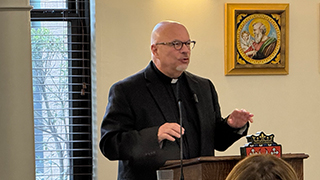
Father John Gabriel preaching on St. Paul and hospitality.
The program also featured Father John Gabriel, V.F., who offered a reflection reemphasizing the significance of St. Paul’s hospitality to all people. Father Gabriel defined hospitality as the “art” of making people feel welcome, with St. Paul as the artist. He pointed to the Letter to the Colossians as the framework for St. Paul’s hospitality and for how others should follow it: “Clothe yourselves with compassion, kindness, humility, meekness, and patience…Above all, clothe yourselves with love…” (Col 3:12, 14).
This hospitality, Father Gabriel explained, was exemplified in St. Paul’s relationship with St. Lydia, an affluent businesswoman who was a “dealer in purple cloth” (Acts 16:14). Lydia extended generous hospitality to Paul and the Church at Philippi. Father Gabriel stressed that hospitality is reciprocal, and St. Paul understood this by both offering hospitality to others and accepting it from St. Lydia. “She became immediately aware that faith implied action,” Father Gabriel stated. “As St. Paul gave us hospitality, so he was willing to receive it from another.”
Father Gabriel concluded his reflection by reminding the audience of St. Paul’s mission of evangelization and the importance of offering hospitality to all people. “[Hospitality] appeals to a common experience,” Father said, “and it exudes a certain warmth, hopefulness, joy, and beauty, and that is Paul, the artist.”
The day of recollection was part of ICSST’s Preaching as Hospitality Formation program that seeks to form seminarians, diaconal students and religious and lay graduate students of theology to be compelling preachers who will offer a hospitality of the heart as they break open the Word of God. The initiatives help to form preachers who will understand and embrace preaching as hospitality — a ministry of inviting, welcoming and offering compassion. The program also focuses on newly ordained priests and deacons and newly appointed pastors (less than five years) who are invited to re-imagine their preaching through the lens of Christian hospitality.
To learn more about ICSST’s Preaching as Hospitality Formation Program, please contact Alyssa Carolan at [email protected].
Categories: Faith and Service