


Reading the Field
Wednesday, October 14, 2026
In the Lead magazine seeks to inform future leaders, generate global dialogue on leadership and build a community that sees more effective leadership as a prerequisite to building a better world.
It is published by the Buccino Leadership Institute, developing leaders at Seton Hall for over 30 years. This edition reaffirms Seton Hall’s commitment to fostering innovative, ethical and impactful leadership. Stay ahead of the curve — explore the Fall 2026 issue of In the Lead.
An Inconvenient Education: The Architecture of Judgment
The pitch is enormous, and for long stretches, Lionel Messi barely moves through it. He strolls, hands loose, reflective, eyes tracking something the cameras haven't found yet. Defenders drift past him unconcerned. Then a back line shifts to cover a run, and something in his stance changes — a half-turn of the hips, weight onto the balls of his feet. The ball arrives, not to where he was, but to where the defense’s shape has just quietly broken. Three touches. The net ripples before the crowd has finished processing that he moved at all.
At 39, during the 2026 FIFA World Cup, Messi covered less distance per 90 minutes than any of the 618 outfield players who logged at least that much time on the pitch. Nearly two-thirds of his movement was simply walking. Yet Argentina won six of its seven matches, reached the World Cup final, and Messi finished among the tournament's leading scorers with eight goals. His brilliance did not deliver the trophy by itself; soccer, like leadership, is ultimately a team sport. But his performance revealed something deeper than technical skill. The stillness was never idleness. It was reconnaissance.
What separates Messi from the players sprinting past him is not skill, exactly — plenty of them can strike a ball as cleanly. It is judgment: the capacity to read a scene most people are still watching unfold, to know what a shifting defense is about to become before it becomes it, and to act only when the position is worth acting on. The goal is the visible decision. Everything that made it inevitable — the reading, the patience, the timing — never shows up on the highlight reel.
Judgment is related to decision-making, but it is not a decision. It is the cultivated capacity from which decisions arise — the ground, formed and enriched over years through experience, reflection and revision. Individual decisions are the plants that emerge from it. The quality of what grows depends substantially on the richness of the ground.
Education has long emphasized knowledge and skills. But leadership demands something beyond technical expertise. What ultimately matters is whether a leader can interpret a situation, weigh competing values and consequences, and make a sound decision amid uncertainty. The longer I have worked in academic leadership, the less convinced I have become that education gives sufficient attention to how that capacity is formed. We know how to teach skills, competencies and knowledge. We know far less about how experience, reflection, responsibility and consequence combine to make someone more judicious over time. Knowledge answers what. Skills answer how. Competencies demonstrate that one can. Judgment answers whether one should.
Noel Tichy and Warren Bennis begin their book Judgment: How Winning Leaders Make Great Calls with a parable. A novice asks an accomplished leader what accounts for his success. The answer is good judgment. Asked where that came from, the leader points to experience — and when pressed about the source of experience, he acknowledges the role of bad judgments. Many experienced leaders recognize themselves in this story. Careers are shaped by good decisions and mistakes: missed signals, flawed assumptions, lessons learned in hindsight.
Yet the story is incomplete. If experience automatically produced good judgment, every leader would grow wiser with age, and every additional year in office would improve the quality of decisions. We know this is not so. Some people repeat the same mistakes for decades. Others develop real judgment in a remarkably short time. The difference lies not in how much experience someone accumulates, but in what they learn from it — a distinction less between experience and inexperience than between examined and unexamined experience, as John Dewey and later Donald Schön each argued from different angles. Reflection of two kinds — reflection-in-action and reflection-on-action — is what turns experience into a revised mental model. Reflection-in-action keeps today’s decision aligned with tomorrow’s purpose. Reflection-on-action makes tomorrow’s judgment wiser than today’s.
No leader sets out to make a bad judgment. The initial choice usually feels defensible given the information, assumptions and constraints at hand. Only later do consequences reveal what was missed. The decisive question is what follows: Does the leader defend the decision and move on, or ask what assumptions failed and what must change before the next call? Ideally, the next decision is made by someone who is no longer quite the same person who made the last one.
This is why leadership is so thoroughly an exercise in judgment. Who do we hire, trust, promote or remove? Which opportunities deserve scarce resources? When should an organization preserve what it has, and when should it break with precedent?
Lee Bolman and Terrence Deal offer a powerful framework: judging the frame through which the situation itself is being understood. Their four-frame model asks leaders to examine organizations structurally, through roles, rules and systems; humanly, through lived experience; politically, through competing interests, alliances and the work of securing support; and symbolically, through meaning, culture and identity. Most consequential decisions contain all four dimensions, even when one initially appears dominant. A budget cut may look structural, but it is also human, political and symbolic. Judgment requires recognizing which realities the initial framing has left out and then making the right call.
The Bolman and Deal framework is useful, but I came to believe it left out an important dimension: how disparate considerations are made coherent. In Leading With Aesthetics: The Transformational Leadership of Charles M. Vest at MIT, I examined how a presidency transformed an institution through judgments about space, design, human experience and identity. These decisions braided together mission, risk, institutional culture and competing constituencies. Aesthetic judgment was how those disparate elements became coherent institutional action.
Judgment has a useful analogue in jurisprudence. A judge does not rule from instinct alone, but through evidence, precedent, interpretation and an obligation to explain the decision. Leadership judgment differs from judicial judgment, yet the analogy is instructive. Neither is an innate talent. Both are cultivated through experience, reflection and disciplined reasoning, requiring an honest understanding of the situation, the people involved and one’s own blind spots.
There is an important distinction, too, between judgment in this sense — judiciousness — and being judgmental in human relationships. Judiciousness delays conclusion long enough to consider context and the possibility that one’s first read is wrong. A genuinely educated person should become less judgmental toward others and more judicious in decisions.
How, then, does judgment develop — and how would an institution know it was happening?
The difficulty is that classroom success and real-world success are not the same thing. A student can learn to satisfy a professor, master assigned material and perform well within known criteria. Professional life is not so orderly. The client is not a professor; the board is not an examination committee. The problem is rarely given in advance, the criteria are contested, and the consequences are borne by people other than the decision-maker — the kind of “wicked problem” Horst Rittel and Melvin Webber described decades ago.
Most educational models separate learning from responsibility: Students study first and practice later or alternate between the two through internships and co-ops. These have real value, but they connect education and practice episodically rather than continuously and reflectively. The Boston Architectural College (BAC) has long operated differently. Students study and practice simultaneously, with workplace learning built into the degree — tracked, assessed and connected to academic outcomes, not adjacent to the curriculum but one of the roots that sustains it.
I have described this model elsewhere as “an inconvenient education.” The inconvenience is not incidental. It comes from refusing to isolate learning from responsibility. Students do not first acquire knowledge in the protected environment of school and only later test it in the world; they do both at once, carrying the pressures of practice back into the classroom while taking academic ideas immediately into professional settings. The value is not simply earlier experience — it is the recurrence: action, reflection, learning, revision and renewed action, week after week. A difficult client meeting can return to the classroom as something to be examined rather than merely endured. A design decision made under pressure can be reconsidered through critique. Practice exposes the limits of academic knowledge; education interrupts the habits of practice. That friction is where experience becomes reflection, and reflection becomes judgment.
An institution can assess this directly — not merely the answers students give, but the quality of the reasoning that produces them. Students can be presented with discipline-specific situational judgment cases involving incomplete information and real consequences, then evaluated on how they frame the problem, weigh alternatives and revise their position as new information appears. Lawrence Kohlberg and Anne Colby offer a model for scoring the structure of reasoning rather than the conclusion alone; Donald Schön adds reflection-in-action and reflection-on-action; Tichy and Bennis extend the assessment through preparation, the call itself, execution and long-term results. Together, these let an institution measure judgment as a developing proficiency rather than a single test score.
Two kinds of evidence support the claim, corresponding to before and after graduation. During the program, students do not advance year to year by grade alone; reflective portfolio reviews function as a gate, requiring students to demonstrate readiness before progressing — a check on judgment under real, if bounded, stakes.
After graduation, the stronger evidence is what the profession itself entrusts graduates on its own terms. The National Council of Architectural Registration Boards reports that the average candidate takes 13 years after graduation to become licensed. BAC students complete NCARB’s Integrated Path to Architectural Licensure before graduation at eight times the national average; seven BAC graduates in this cohort satisfied all the requirements for licensure upon graduation. According to the federal College Scorecard data, BAC’s B.Arch graduates post the nation’s highest median earnings five years out, and our M.Arch ranks second highest. By the College’s surveys, corroborated by the practice portfolios every student assembles, 46 percent of graduating students already hold positions managing others on graduation day. Yes, on graduation day. If judgment shows itself in what others are willing to entrust to you once the stakes are real, this is what that entrustment looks like: faster licensure than the national average, and rapid advancement into roles where the cost of poor judgment is high.
The purpose of education is not to protect students from error or postpone responsibility until the degree is complete. It is to create conditions in which decisions can be made, examined, revised, reflected and tried again while the stakes are still manageable. Good judgment may grow from experience, but only reflection turns experience into learning. That is why education for judgment is necessarily inconvenient: It places knowledge in contact with consequence and asks students to act before every answer is available. Its real test is not what graduates know when they leave, but whether they go on becoming more judicious.
Messi’s eight goals will be replayed for years — each one a burst of three touches,
a net rippling, a crowd on its feet. What won’t be replayed is the walking: the long,
unglamorous stretches when nothing appeared to be happening, when he was reading a
defense that hadn’t yet revealed its shape. That is where the goal was actually made.
An inconvenient education does not shorten that walk. It insists that students take
it while someone is still there to help them read the field.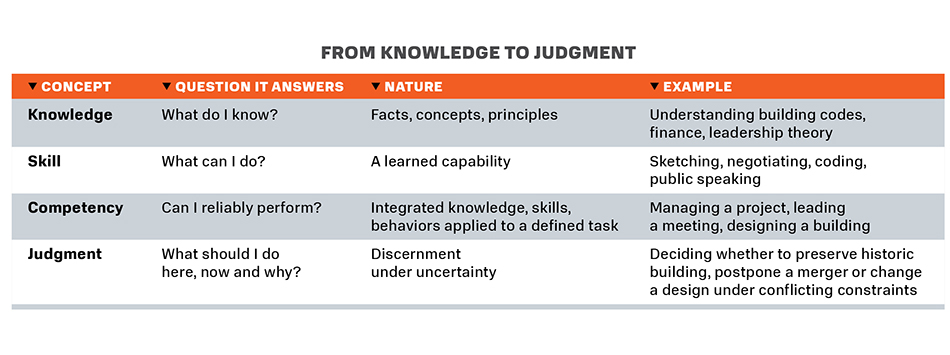
Categories: Business