
Meeting Seton Hall Exchange Students: Sharing University Experiences and Global Perspectives
Wednesday, March 25, 2026
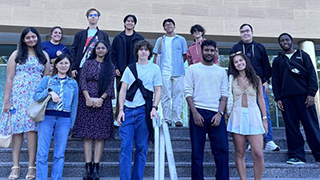
University exchange opportunities bring global perspectives to campus.
This semester, Seton Hall University hosts eight exchange students whose academic interests and cultural perspectives are enriching classrooms and campus life. The Office of International Programs (OIP) recently interviewed three students: Marni Morgan Cronin from University of Westminster, the United Kingdom; Tomás Cabrera Cairati from Universidad Católica de Santa Fe, Argentina; and Toko Kobayashi from Rikkiyo University, Japan.
Marni, a second-year undergraduate law student, chose Seton Hall for its English-speaking environment and the similarities between U.S. and U.K. legal systems. With a growing interest in criminology, she has found her Seton Hall courses both engaging and practical. “Professors bring real-world experience into the classroom,” she said, noting that discussions are far more interactive than she expected. While her impressions of the U.S. had largely come from television, she found the transition and adjustment to her routine at Seton Hall a smooth one. “It’s not too different from the U.K., and many comforts feel familiar,” she explained.
Still, adjusting socially took time. “At first, it was hard to make friends since many students already knew each other,” Marni said. Over time, however, she has found her place. She also enjoys taking trips to nearby New York City and appreciating the scenery of Manhattan. Despite a lengthy visa process that included extensive social media vetting and long wait times at the U.S. embassy in London, Marni says the experience has been worthwhile. “I’d love to come back and study here again,” she added.
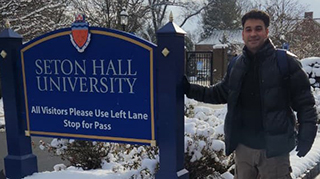
Tomás Cabrera near the main entrance of campus.
Tomás, an international relations major from Argentina, arrived at Seton Hall to complete his final research project on U.S. Treasury bonds and their global influence. Drawn to New Jersey’s proximity to the United Nations headquarters and its role as a hub for finance, he was eager to experience the U.S. firsthand. “I wanted to understand the political system and see how things work here,” he said.
Living in campus housing, Tomás has embraced Seton Hall’s strong sense of school spirit and praised professors for their engaging teaching styles. He also appreciates the emphasis on attendance and continuous assessment, noting that final exams carry less weight than in his home institution. Still, some differences stand out. “Back home, exams are often oral. Here, everything is written. It took me a while to get used to,” he said.
Socially, Tomás has observed that U.S. students tend to be busier. “People are kind and say hello, but they are often focused on their own schedules,” he explained. In Argentina, he said, students frequently gather to share mate, traditional tea of Argentina, and spend time together. On campus, however, he has found connection in small moments, like meeting a friend in the dining hall.
Tomás enjoys taking walks around the South Orange neighborhood. He observed that many houses display American flags in the neighborhood, which is not very common in Argentina. On campus, Tomás appreciates the resources that are available such as the innovation lab and finance facilities, including a Bloomberg-equipped trading room. Experiencing snowfall for the first time has been a highlight. “South Orange is beautiful, especially in the snow,” he said.
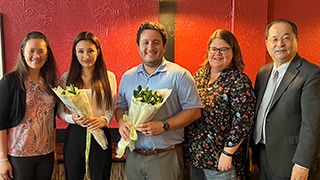
Toko (second from left) with Seton Hall professors and administrator at Professor Shigeru Osuka’s Welcome Luncheon.
Toko, a sociology major from Japan focusing on international relations, chose Seton Hall for its strong diplomacy program and its proximity to New York City. Toko’s father lived in New Jersey briefly and recommended New Jersey to her when she was looking for study abroad opportunities to explore U.S. perspectives on global affairs, particularly U.S.-Japan relations. She describes American culture as more direct than what she is used to. “In Japan, people are polite and may not say if they dislike something. Here, people are more straightforward,” she said. Despite initial language challenges, Toko has found strong support from Seton Hall faculty. After informing professors about her needs, she was allowed to record lectures, and instructors made efforts to speak more clearly.
Like her peers, Toko noted that forming friendships can be difficult during a short exchange period. Still, she has found the campus welcoming and full of opportunities. “There are so many events happening... which made campus life very exciting,” she said. Friends and classmates have helped her get involved, making her experience more meaningful. Toko also works as a Japanese language tutor for the Department of Languages, Literatures, and Cultures, which helps students who are taking Japanese language classes. Toko plans to apply for admission and hopes to return to Seton Hall to study for her master’s degree in international relations with the School of Diplomacy.
Reflecting on her journey, Toko’s advice to Seton Hall students who wish to study abroad in Japan is to prepare culturally as well as academically. “If you want to study in Japan, learning some basic Japanese and understanding social norms, like being quiet in public, can really help,” she said.
Together, Marni, Tomas and Toko highlight the diversity and global engagement that define the Seton Hall community. Their stories underscore both the challenges and rewards of studying abroad, offering a reminder that learning extends far beyond the classroom.
Categories: Education, Nation and World